


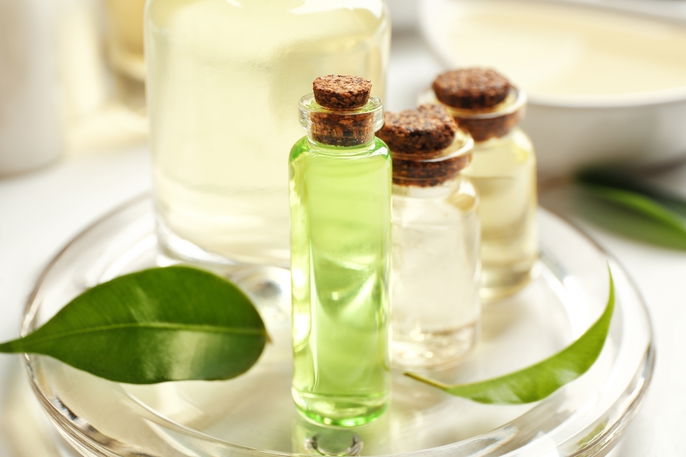
Tea tree oil is an essential oil from Melaleuca alternifolia, often called the tea tree, and has been used for centuries in traditional care. Modern research links tea tree oil to antiseptic, antibacterial, antifungal, antiparasitic, and anti-inflammatory activity.
When applied to the skin, tea tree oil is commonly used to disinfect minor wounds, support acne treatment, and help manage nail fungus. Tea tree oil is also used for dandruff, athlete’s foot, lice and insect repellent blends, and as an antiseptic rinse to help reduce bad breath.
Because tea tree oil may irritate sensitive skin, it is often diluted in a carrier oil or used in prepared products like gels and shampoos. Tea tree oil is toxic if swallowed, so it should only be used on the skin as directed. It’s also important to watch for possible side effects such as redness, burning, itching, or allergic reactions.
Health benefits
The main benefits of using tea tree oil are:
1. Disinfecting wounds
Because of its bactericidal properties, tea tree oil can help eliminate bacteria such as E. coli, S. pneumoniae, H. influenzae, S. aureus, and other bacteria that may cause infections through open wounds. It may also help speed healing and reduce local inflammation.
How to use: mix 1 drop of tea tree oil with 1 tablespoon of almond oil, apply a small amount to the wound, and cover with gauze. This can be repeated 1 to 2 times a day until the wound has fully healed.
2. Improving acne
Tea tree oil may help improve acne because it has anti-inflammatory properties and may inhibit the growth of bacteria such as Propionibacterium acnes, which is associated with acne.
How to use: use a gel or fluid that contains tea tree oil, or mix 1 mL of tea tree oil with 9 mL of water and apply the mixture to the affected areas 1 to 2 times a day.
3. Treating nail fungus
Because of its antifungal properties, tea tree oil may help treat nail fungus. It can be used alone or alongside other remedies.
How to use: mix 2 to 3 drops of tea tree oil into a carrier oil such as almond oil or coconut oil, then apply to the affected nails.
4. Reducing dandruff
Tea tree oil can be effective for dandruff, improving the look of the scalp and helping soothe itching.
How to use: some shampoos contain tea tree oil and can be used daily. Another option is to add a few drops of tea tree oil to regular shampoo and use it whenever washing the hair.
Read more about more home remedies for dandruff to help manage itching and irritation.
5. Repelling insects
Tea tree oil can also be used as an insect repellent and may be more effective than some store-bought products that contain DEET. It may also be used to help prevent lice infestation or support lice removal, and it may relieve itching caused by these parasites.
How to use: to help repel insects, make a spray by mixing tea tree oil with other essential oils, such as lavender or citronella, and dilute it in almond oil.
To help treat lice, mix about 15–20 drops of tea tree oil into your regular shampoo. Massage the mixture gently into the scalp using your fingertips.
6. Treating athlete’s foot
Athlete’s foot is a fungal infection that can be difficult to treat, even with antifungal medications. Using tea tree oil alongside treatment may help improve results and shorten treatment time, and it may also help ease symptoms such as itching and inflammation.
How to use: mix 1/2 cup of arrowroot powder with 1/2 cup of baking soda, then add about 50 drops of tea tree oil. This mixture can be applied 1 to 2 times a day.
7. Preventing bad breath
Tea tree oil may help fight microorganisms that contribute to cavities and bad breath because of its antiseptic and antibacterial properties.
How to use: for a homemade mouth rinse, add 1 drop of tea tree oil to 1 cup of warm water, mix, and swish for about 30 seconds.
8. Helping treat genital infections
Tea tree oil may be used to support treatment of genital infections, such as yeast infections, bacterial vaginosis, or trichomoniasis.
Because of its antimicrobial properties, it may help relieve symptoms and support recovery, but it does not replace treatment recommended by a doctor.
How to use: dilute tea tree oil with another oil, such as almond oil, and apply to the genital area.
Side effects
Tea tree oil is generally well tolerated, but side effects can occur, although they are uncommon. These may include skin irritation, allergic reactions, itching, burning, redness, and dry skin.
Tea tree oil is toxic if swallowed and may cause confusion, difficulty controlling muscles and movement, and decreased consciousness.
Contraindications for use
Tea tree oil should only be used externally and should not be taken by mouth because it can be toxic when ingested. It should always be diluted before applying to the skin, especially for people with sensitive skin, to reduce the risk of irritation.