


- Heart tests can help detect heart problems early and may include ECGs, Holter monitors, stress tests, cardiac imaging, and blood tests.
- The right test depends on your symptoms, medical history, and the heart condition your healthcare provider is evaluating.
- Blood tests such as troponin and imaging tests can help diagnose heart attacks, assess heart function, and identify cardiovascular risk factors.
Heart tests commonly used to evaluate how well the heart is working include an electrocardiogram, echocardiogram, Holter monitor, exercise stress test, ambulatory blood pressure monitoring, and laboratory tests. Blood tests may include troponin, total cholesterol, and a complete cholesterol panel.
These tests can help detect heart problems early, sometimes before serious complications develop. When necessary, early diagnosis allows treatment to begin sooner.
A cardiologist or primary care provider may recommend these tests as part of a routine checkup or based on a person’s symptoms and medical history. The specific tests ordered will depend on the condition being investigated.
Main types
The main tests used to evaluate the heart include:
1. Holter monitor
A Holter monitor is a test that records the heart’s rhythm, usually over 24 hours. It uses a portable recorder connected to electrodes similar to those used during an electrocardiogram (ECG), allowing it to record every heartbeat.
Although monitoring commonly lasts 24 hours, more complex cases may require 48 hours or up to one week to properly evaluate the heart rhythm.
While wearing the monitor, the person should record daily activities and symptoms in a diary. This may include strenuous activity, heart palpitations, or chest pain, which allows the doctor to compare symptoms with the heart rhythm at that time.
When it's recommended: A Holter monitor is mainly recommended when an arrhythmia is suspected but does not appear on a resting ECG. It may also be ordered for unexplained symptoms such as dizziness, heart palpitations, or fainting.
The test may also be used to evaluate how well antiarrhythmic medications or implanted cardiac devices, such as pacemakers, are working. It can also be used to monitor patients after a heart attack.
Contraindications: A Holter monitor is suitable for most people, although skin irritation or open wounds may make it difficult for the electrodes to stay in place.
2. Ambulatory blood pressure monitoring
Ambulatory blood pressure monitoring, also called ABPM, records blood pressure over a 24-hour period. It uses a cuff placed around the arm and a portable recorder, usually worn at the waist, that measures blood pressure at intervals set by the doctor.
The person should generally continue normal daily activities and record what they were doing each time a measurement was taken. Activities such as eating, walking, or climbing stairs can temporarily affect blood pressure.
When it's recommended: ABPM may be recommended when high blood pressure is suspected or when the diagnosis is uncertain. According to the U.S. Preventive Services Task Force (USPSTF), ambulatory blood pressure monitoring is an important method for confirming hypertension and identifying white-coat hypertension.
ABPM can also help determine whether blood pressure medications are controlling blood pressure effectively throughout the day and night.
Contraindications: The test may not be accurate if the cuff does not fit the arm correctly, including in people with very small or very large arms. Tremors and some arrhythmias may also interfere with reliable measurements.
3. Echocardiogram
An echocardiogram, also called a cardiac ultrasound, uses sound waves to produce real-time images of the heart and its movement.
This test can evaluate the size and thickness of the heart walls, the amount of blood the heart pumps, and how well the heart valves are working. It provides detailed information about the heart’s structure and function.
Different types of echocardiograms are available, including transthoracic and transesophageal echocardiograms. An ultrasound-enhancing agent may also be used to improve image quality.
When it's recommended: An echocardiogram may be ordered to investigate symptoms such as shortness of breath and swelling in the legs, which may be signs of heart failure.
It can also detect heart valve abnormalities, changes in the shape of the heart or blood vessels, and tumors or other masses in the heart.
Contraindications: A standard transthoracic echocardiogram has no absolute contraindications. However, obtaining clear images may be more difficult in people with breast implants, obesity, or an inability to lie on their side, such as critically ill or intubated patients.
4. Laboratory tests
The main laboratory tests that may help evaluate heart health include:
-
BNP or NT-proBNP
-
Fasting blood glucose
-
Total cholesterol and a complete cholesterol panel
-
Triglycerides
-
Sodium, potassium, and other electrolytes
These blood tests can help identify cardiovascular risk factors, detect injury to the heart muscle, and assess conditions such as heart failure. According to the American College of Cardiology (ACC) and the American Heart Association (AHA), cardiac troponin is the preferred biomarker for diagnosing acute myocardial infarction, commonly called a heart attack.
Electrolyte testing can identify abnormalities that may affect the heart rhythm or the safe use of certain medications. Other blood tests may help estimate a person’s risk of developing cardiovascular disease.
When they're recommended: These tests may be ordered when a heart condition such as a heart attack or heart failure is suspected. They may also be used to monitor risk factors such as high cholesterol and diabetes or to evaluate the effectiveness and safety of medications.
Blood tests may also be included in routine checkups for people with cardiovascular risk factors, including high blood pressure, obesity, or a family history of heart disease.
Contraindications: Blood tests used to evaluate heart health generally have no absolute contraindications and are considered safe.
5. Myocardial perfusion scan
A myocardial perfusion scan is an imaging test that evaluates blood flow to the heart muscle and how well the heart is functioning. It uses a small amount of radioactive material called a radiotracer.
During the test, the radiotracer is given and travels to areas of the heart receiving blood. A special camera detects the material and creates images that can reveal areas with reduced blood flow.
The test may be performed both at rest and during physical activity. This allows the doctor to compare blood flow to the heart muscle under different conditions.
When a person cannot exercise, a medication may be given to produce effects similar to those of physical activity.
When it's recommended: A myocardial perfusion scan may be ordered when coronary artery disease is suspected, including in people with angina or chest pain that may be related to the heart. It may also be performed after a heart attack or before certain heart procedures or surgeries.
Contraindications: Tell your doctor if you are pregnant or breastfeeding before the test, since it uses a small amount of radioactive material. The exercise or medication portion may not be safe for people with certain serious arrhythmias or unstable heart conditions.
6. Electrocardiogram
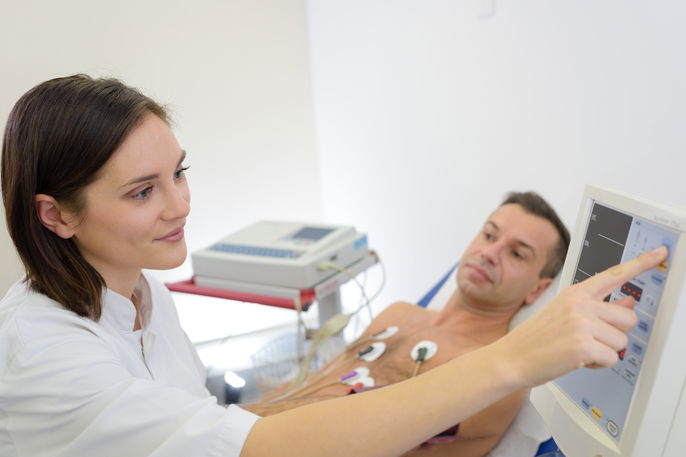
An electrocardiogram, also called an ECG or EKG, evaluates the heart’s electrical activity and rhythm. The test is performed while the person is lying down, with wires connected to small electrodes placed on the chest and sometimes the arms and legs.
An ECG is often one of the first tests used to evaluate the heart. It may also be included as part of a routine cardiology appointment.
The test is quick and painless and can often be performed in a doctor’s office.
When it's recommended: An ECG may be used to detect arrhythmias or irregular heartbeats. It can also identify changes associated with a recent or previous heart attack and electrical changes that may be related to high or low potassium levels.
Contraindications: An ECG can be performed on almost anyone. However, skin wounds, excessive chest hair, or other factors that interfere with electrode placement may make the test more difficult to perform accurately.
7. Cardiac CT scan
A cardiac computed tomography scan, also called a cardiac CT scan, uses X-rays to produce detailed images of the heart.
In many cases, an iodinated contrast agent is injected into a vein in the arm to improve the view of the coronary arteries.
During the test, the scanner takes multiple images of the heart within a few minutes. These images can reveal plaque buildup, narrowing of the arteries, and abnormalities in the heart’s structure.
When it's recommended: A cardiac CT scan may be ordered when coronary artery disease is suspected, such as in a person with chest pain or an intermediate risk of heart disease.
It may also be used to evaluate plaque in the coronary arteries, investigate structural abnormalities, or help plan certain heart procedures.
Contraindications: Cardiac CT is generally avoided during pregnancy unless the test is medically necessary. When iodinated contrast is required, additional precautions may be needed for people with a previous severe contrast reaction or significantly impaired kidney function.
The test may also be limited in people with significant arrhythmias or an inability to remain still.
8. Cardiac MRI
Cardiac magnetic resonance imaging, also called cardiac MRI, uses a strong magnetic field and radio waves to produce detailed images of the heart.
This test can evaluate the heart’s structure and function, the size of its chambers, the movement of the heart muscle, and the presence of scarring, inflammation, or heart muscle disease.
Because it does not use ionizing radiation, cardiac MRI can be useful for providing additional information after other heart tests.
When it's recommended: Cardiac MRI may be ordered when a detailed evaluation of the heart’s structure and function is needed. It may be used to investigate cardiomyopathy, inflammation of the heart muscle, damage from a previous heart attack, or the progression of certain heart conditions.
Contraindications: Cardiac MRI may not be appropriate for people with certain implanted devices, metallic implants, or metal fragments in the body. However, many newer pacemakers and other cardiac devices are MRI-conditional and can be safely scanned under specific conditions and specialized safety protocols.
The test may also be difficult for people with severe claustrophobia or an inability to remain still. When gadolinium contrast is needed, its use should be carefully evaluated in people with severe kidney disease.
9. Exercise stress test
An exercise stress test, also called a treadmill stress test, is used to identify changes in blood pressure, heart rhythm, or electrical activity during exercise.
The test reproduces the physical demands of activities such as climbing stairs or walking uphill. These activities may cause discomfort or shortness of breath in people with certain heart conditions.
When it's recommended: An exercise stress test may be used to investigate suspected coronary artery disease, arrhythmias, or shortness of breath during physical activity. It may also help evaluate the effectiveness of treatment or cardiac rehabilitation.
Contraindications: The test should not be performed during certain acute or unstable medical conditions, such as a serious active infection, unstable heart symptoms, or decompensated heart failure. People who cannot safely walk on a treadmill or pedal a stationary bicycle may need a different type of stress test.
10. Cardiac catheterization
Cardiac catheterization is an invasive procedure in which a thin tube called a catheter is inserted into a blood vessel in the arm or groin and guided toward the heart. This allows the doctor to examine the coronary arteries and heart chambers and identify narrowed or blocked areas.
When it's recommended: Cardiac catheterization may be used to diagnose or confirm coronary artery disease, evaluate narrowed or blocked arteries, and investigate angina or symptoms of heart failure.
It may also be performed before or during an interventional procedure, such as angioplasty or stent placement.
Contraindications: There are few absolute contraindications when cardiac catheterization is urgently needed. However, the procedure may need to be postponed or performed with additional precautions in people with an active infection, a previous severe reaction to iodinated contrast, severe kidney impairment, or an uncontrolled bleeding disorder.
The risks must also be carefully evaluated in people with serious medical conditions that may increase the chance of complications.
11. Coronary angiography
Coronary angiography is performed during cardiac catheterization. It involves injecting an iodinated contrast agent into the coronary arteries through a catheter that has already been placed.
X-ray images are then taken to provide detailed information about the structure of the arteries, blood flow, and possible narrowing or blockages.
When it's recommended: Coronary angiography may be used to diagnose congenital heart defects, narrowing or blockage of the coronary arteries, abnormal blood flow within the heart, and certain heart valve abnormalities.
Contraindications: A previous severe reaction to iodinated contrast is an important consideration but is not always an absolute contraindication. The doctor should be informed so that preventive measures, alternative contrast strategies, or another test can be considered.
Kidney function and bleeding risk should also be evaluated before the procedure.
12. Chest X-ray
A chest X-ray, also called chest radiography, evaluates the outline and size of the heart and aorta. It may also detect fluid buildup in the lungs, which can be associated with heart failure.
A chest X-ray is considered a supplemental test. It provides a general view of the chest but does not give detailed information about how the heart is functioning, so other heart tests are often needed.
When it's recommended: A chest X-ray may be ordered to evaluate an enlarged heart or enlarged blood vessels. It may also reveal calcium deposits in the aorta, which can become more common with age.
The test also evaluates the lungs and may detect fluid buildup, congestion, or other abnormalities.
Contraindications: Pregnancy is not an absolute contraindication to a chest X-ray. A medically necessary chest X-ray may still be performed during pregnancy, but anyone who is pregnant or may be pregnant should tell the healthcare team before the test.
