


- Cardiac arrest is a life-threatening condition that happens when the heart stops beating or can no longer pump blood effectively.
- Warning signs may include severe chest pain, shortness of breath, cold sweats, tingling in the left arm, or intense palpitations.
- If a person is unresponsive and not breathing, call 911 and start CPR right away until emergency help arrives or an AED becomes available.
Cardiac arrest occurs when the heart stops beating or can no longer pump blood effectively. As a result, blood does not reach the body’s organs, putting the person’s life in immediate danger.
Cardiac arrest can happen suddenly and may have several causes. It is more common in people with heart disease, respiratory failure, or serious injuries that affect the heart’s normal function.
Warning signs of cardiac arrest may include severe chest pain, shortness of breath, tingling in the left arm, or intense palpitations. If a person is not breathing, start CPR right away and call 911 or local emergency services.

Cardiac arrest symptoms
Warning signs that may appear before cardiac arrest include:
-
Severe chest pain that spreads to the abdomen or back
-
Severe headache
-
Shortness of breath or difficulty breathing
-
Blurred vision
-
Cold sweats and heart palpitations
Cardiac arrest should be suspected if a person is unconscious, unresponsive, not breathing, and has no pulse.
What to do during cardiac arrest
If someone is experiencing cardiac arrest, follow these steps:
- Try to wake the person by speaking to them and gently checking if they respond.
- If they do not respond, check whether they are breathing by placing your face close to their nose and mouth and looking to see if their chest is moving.
-
If the person is breathing: place them in the recovery position, call 911, and continue to monitor their breathing.
-
If the person is not breathing: call 911 or ask someone else to call, then begin CPR.
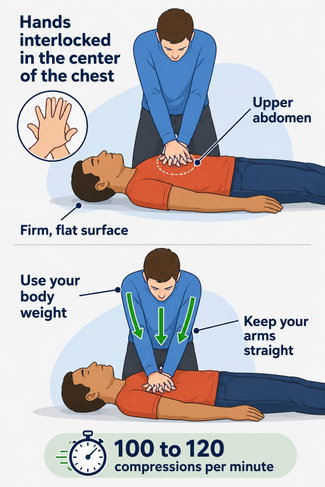
To perform CPR:
- Lay the person on their back on a firm, flat surface, such as the floor.
- Place the heel of one hand on the center of the chest, on the lower half of the breastbone. Place your other hand on top and interlock your fingers.
- Keep your arms straight and your shoulders directly over your hands.
- Push hard and fast, compressing the chest about 2 inches (5 cm), but no more than 2.4 inches (6 cm). Allow the chest to fully recoil after each compression.
- According to the American Heart Association, chest compressions should be performed at a rate of 100 to 120 compressions per minute until emergency medical services arrive or an automated external defibrillator (AED) becomes available.
If you are trained and willing to provide rescue breaths, perform 30 chest compressions followed by 2 rescue breaths. If you are not trained or are not comfortable giving rescue breaths, continue hands-only CPR until emergency medical services arrive.
What causes cardiac arrest?
Cardiac arrest occurs when there is a disruption in the heart’s electrical activity. This prevents the heart from contracting properly and pumping blood to the rest of the body.
The exact causes of sudden cardiac arrest are not always clear. However, several conditions can increase the risk, including:
1. Arrhythmia
An arrhythmia is any abnormal heart rhythm. Most arrhythmias are not life-threatening and allow people to maintain a good quality of life when properly treated.
However, in rare cases, ventricular fibrillation may develop. This is a life-threatening heart rhythm that can cause sudden cardiac arrest.
2. Coronary artery disease
Cardiac arrest may also occur in people with coronary artery disease. This condition causes cholesterol plaques to build up inside the arteries, reducing blood flow to the heart and affecting the heart muscle and its electrical activity.
3. Changes in potassium levels
Very high or very low potassium levels can occur in serious medical conditions and may lead to cardiac arrest.
4. Respiratory failure
Respiratory failure occurs when the lungs cannot properly exchange oxygen and carbon dioxide. This can increase carbon dioxide levels in the blood, interfere with heart function, trigger arrhythmias, and raise the risk of cardiac arrest.
5. Pulmonary embolism
A pulmonary embolism is a serious condition in which one or both arteries in the lungs become blocked by a blood clot. This clot usually travels through the bloodstream from another part of the body.
This blockage reduces blood flow through the lungs, limits oxygen delivery to the affected lung tissue, and can lead to cardiac arrest.
Treatment options
Initial treatment for cardiac arrest focuses on getting the heart to beat again. According to the American Heart Association, emergency treatment for cardiac arrest includes CPR and the use of an AED, which can deliver an electrical shock to help restore a normal heart rhythm.
Once the heart starts beating again, tests are needed to identify what caused the cardiac arrest. This allows the underlying cause to be treated and helps reduce the risk of another cardiac arrest.
In some cases, a pacemaker or an implantable cardioverter-defibrillator (ICD) may be recommended. These small devices help prevent or correct life-threatening abnormal heart rhythms that can lead to cardiac arrest.
To reduce the risk of cardiac arrest, it is important to properly manage any existing heart condition, maintain a healthy lifestyle, and reduce stress whenever possible.
When to call 911
If you notice symptoms that could signal a higher risk of cardiac arrest, such as chest pain, shortness of breath, tingling, blurred vision, or cold sweats, seek immediate medical evaluation.
