


- Keratoacanthoma is a fast-growing skin tumor that usually appears as a firm, round lump on sun-exposed skin.
- It can look very similar to squamous cell carcinoma, so a dermatologist may request a biopsy to confirm the diagnosis.
- Treatment usually involves surgical removal, although topical medications or intralesional therapies may be used in selected cases.
Keratocanthoma is a benign skin tumor that grows quickly. It usually causes a round, firm, well-defined lump on sun-exposed areas of skin, such as the forehead, nose, upper lip, arms, and hands.
This type of lesion can be caused by UV exposure from the sun, genetic factors, or skin trauma. Because it can look very similar to squamous cell carcinoma, an accurate diagnosis is important.
Treatment for keratoacanthoma is guided by a dermatologist. It usually involves surgical removal of the lesion, with topical medications or intralesional therapies used in selected cases.
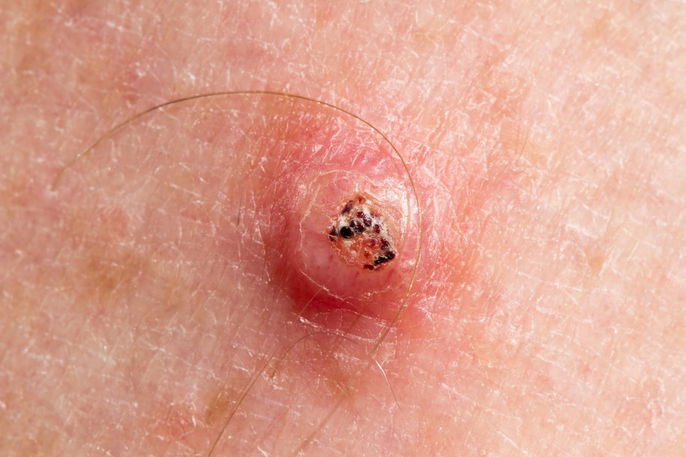
Main symptoms
The main symptom of keratocanthoma is a lump on the skin with the following characteristics:
-
Firm and well-defined
-
1 to 2 cm in size in most cases
-
Skin-colored or slightly red
-
Dome-shaped, like half of a sphere
-
Hardened crust in the center of the lesion
Keratoacanthoma most often appears on sun‑exposed areas such as the face, scalp, neck, and the backs of the hands, and is less common on the chest. It usually does not cause any other symptoms.
However, it is important to see a dermatologist to confirm the diagnosis and rule out other conditions with a similar appearance, such as squamous cell carcinoma.
Confirming a diagnosis
Keratoacanthoma is usually diagnosed by a dermatologist during a physical examination, in which the doctor evaluates the lesion’s appearance.
Dermoscopy can also be used to examine the skin in more detail. Because keratoacanthoma can closely resemble squamous cell carcinoma, a type of skin cancer, the doctor may also request a skin biopsy to confirm the diagnosis.
Different stages
Keratoacanthoma can be classified into different stages:
The timing of each stage can vary from person to person. The stage of keratoacanthoma is identified by the dermatologist through diagnostic exams.
Possible causes
The main causes of keratoacanthoma are:
-
Exposure to UV light from the sun
-
Genetic factors
-
HPV infection
-
Exposure to chemicals, such as tar, pitch, or mineral oils
-
Skin trauma or radiation
In addition, the use of medications such as vismodegib or sonidegib for basal cell carcinoma, or vemurafenib, dabrafenib, or encorafenib for melanoma, also appears to increase the risk of keratoacanthoma.
Keratoacanthoma occurs more often in men, people between 50 and 69 years old, and people with a weakened immune system.
Main types
The main types of keratoacanthoma are:
1. Solitary keratoacanthoma
Solitary keratoacanthoma is the most common type. It is characterized by a single skin lesion that is 1 to 2 cm in diameter and grows quickly.
This type of keratoacanthoma usually regresses on its own within 4 to 6 months.
2. Keratoacanthoma centrifugum marginatum
Keratoacanthoma centrifugum marginatum is a rare type that grows along the outer edges while healing occurs in the center of the lesion.
This type of keratoacanthoma can reach 20 cm or more in size and usually does not regress on its own.
3. Giant keratoacanthoma
Giant keratoacanthoma is also a rare type. It is characterized by lesions that are 2 cm or larger and mainly affects the nose or eyelids.
4. Multiple familial keratoacanthoma
Multiple familial keratoacanthoma of Witten and Zak is caused by autosomal dominant genetic mutations.
This means that if one parent has the defective gene, there is a 50% chance of passing the altered gene to the child and causing the condition.
This type of keratoacanthoma usually appears in childhood and mainly affects the nose and cheeks.
This rare type is characterized by many tiny skin lesions that look similar to milia, as well as typical keratoacanthoma lesions and ulcerated nodules.
5. Generalized eruptive keratoacanthoma
Generalized eruptive keratoacanthoma of Grzybowski is also a rare type that affects the face, upper trunk, tongue, mouth, larynx, or fingers.
This type of keratoacanthoma, also called Grzybowski syndrome, is characterized by hundreds to thousands of skin lesions that are 1 to 5 mm in size and cause intense itching.
Treatment options
Keratoacanthoma treatment should be directed by a dermatologist and usually involves removing the lesion and, in some cases, using medications.
The main treatments for keratoacanthoma are:
1. Surgery
Surgery for keratoacanthoma is performed by a dermatologist to remove the entire skin lesion and some surrounding healthy tissue.
This type of surgery is done with local anesthesia, has a quick recovery, and leaves a small scar in the area.
2. Cryotherapy
Cryotherapy is also a treatment option for keratoacanthoma. It involves freezing the skin lesion with liquid nitrogen.
Cryotherapy does not require anesthesia because it does not cause pain. However, it is common for the treated area to become red and slightly swollen.
3. Topical medications
Topical medications for keratoacanthoma may be prescribed by a dermatologist to help eliminate skin lesions.
The main topical medications for keratoacanthoma are:
-
5-fluorouracil (5-FU), which helps eliminate the cells that cause the lesion
-
Imiquimod, which helps strengthen the immune system so it can eliminate the cells in the lesion.
The type of topical medication depends on the characteristics of the skin lesion, such as its size and location, as well as the type of keratoacanthoma.
4. Intralesional chemotherapy
Intralesional chemotherapy is performed by a dermatologist in cases of solitary keratoacanthoma when surgery is contraindicated or when the skin lesion is difficult to access, for example.
This type of treatment involves applying chemotherapy drugs, such as bleomycin or methotrexate, directly into the keratoacanthoma lesion.
This causes the keratoacanthoma cells to die and be eliminated.
5. Regular follow-up
It is important to know that new keratoacanthomas may appear after a lesion is removed. For this reason, regular follow-up with a dermatologist is important.
How to prevent
To prevent keratoacanthoma, especially in people with a family history or previous skin lesions, it is very important to avoid sun exposure, especially during the hottest hours of the day.
In addition, sunscreen should be applied whenever going outdoors, preferably with SPF 50 or higher. According to the American Academy of Dermatology, sun protection should also include seeking shade and wearing protective clothing, such as long sleeves, a wide-brimmed hat, and sunglasses with UV protection.
People at higher risk should also avoid smoking and check their skin regularly to detect lesions early.