


- Melanoma is an aggressive skin cancer that can appear as a changing mole, spot, or skin mark.
- Common warning signs include asymmetry, irregular borders, uneven color, growth, itching, or easy bleeding.
- Treatment depends on the stage of the cancer, and early diagnosis can increase the chances of a cure.
Melanoma is a malignant skin cancer that develops in melanocytes, the skin cells that produce melanin, the substance that gives skin its color. It may appear as asymmetrical moles, spots, or skin marks with irregular borders and varied colors.
This type of skin cancer is more common in fair-skinned adults and in areas frequently exposed to UV radiation from the sun or tanning beds. Although less common, melanoma can also develop in the eyes, nails, mucous membranes, and other areas such as the gastrointestinal tract.
Melanoma is an aggressive cancer that can spread to other organs. For this reason, a dermatologist should be consulted at the first sign of skin changes, as early diagnosis can make treatment easier and increase the chances of a cure.
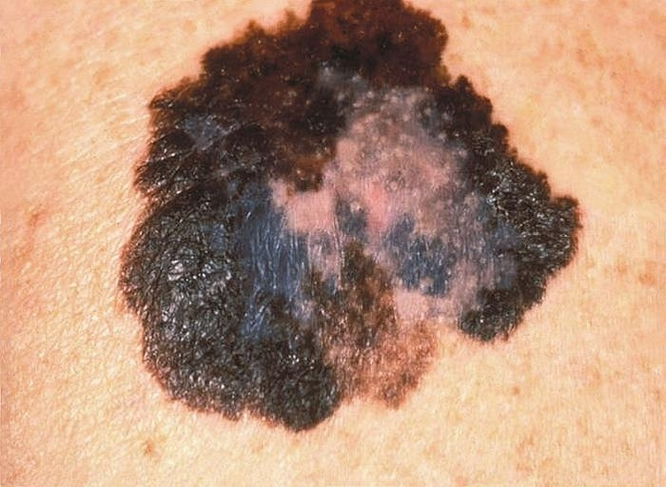
Melanoma symptoms
The main symptoms of melanoma are moles, spots, or marks on the skin with the following characteristics:
-
Asymmetry, in which one half of the spot looks different from the other
-
Irregular borders or edges
-
Different colors, such as red, blue, brown, black, or white
-
Diameter greater than 6 mm
-
Raised surface
-
Increase in size, or change in color or shape
-
Itching or easy bleeding
-
Sores that take a long time to heal or ulcers
These symptoms may appear in a new or existing mole or spot on the skin, or in the mucous membranes or nails.
Also recommended: What Melanoma Looks Like (with Pictures): 5 Signs tuasaude.com/en/what-melanoma-looks-likeOther symptoms may also occur if melanoma has spread to other parts of the body. These can vary depending on the organ affected, such as the lungs, brain, liver, bones, or intestines.
Confirming a diagnosis
Melanoma is diagnosed by a dermatologist or oncologist by assessing the mole, mark, or skin spot with dermoscopy, reviewing the person’s health history, and performing a physical exam of the lymph nodes.
According to the CDC, the ABCDE signs used to assess possible melanoma include asymmetry, irregular borders, uneven color, a diameter larger than a pea, and changes in the mole or spot over time.
To confirm the diagnosis, the doctor should perform a skin biopsy, removing a sample or the entire mole, lesion, or skin spot so it can be analyzed in a laboratory to check for malignant cells.
Possible causes
Melanoma is caused by damage to melanocytes, which are the skin cells responsible for producing melanin, the pigment that gives skin its color. These damaged cells begin to multiply quickly, abnormally, and uncontrollably.
This damage is caused by a combination of genetic and environmental factors, mainly exposure to UV rays from the sun or tanning beds.
Melanoma can appear anywhere on the body, even in areas that are not exposed to UV radiation, such as the eyes or mucous membranes of the mouth, nose, throat, anus, vagina, or gastrointestinal tract.
Risk factors
Some factors that may increase the risk of developing melanoma include:
-
Family history of melanoma
-
Fair skin, blond or red hair, and blue eyes
-
Sunburning easily or having a history of sunburns
-
Freckles or benign and/or dysplastic melanocytic nevi
-
Having many moles or unusual moles on the skin
-
Having had an organ transplant or blood cancer
People with one or more of these risk factors should have regular appointments with a dermatologist for a complete skin exam to identify possible changes that may be an early sign of skin cancer.
Main types
The types of melanoma vary depending on where they appear and how they develop. The main types are:
1. Superficial spreading melanoma
Superficial spreading melanoma is the most common type of melanoma. It initially develops in the most superficial layers of the skin and can spread to deeper layers.
This type of melanoma begins as brown or light-brown areas on the skin, or as small reddish, white, black, or blue spots.
2. Nodular melanoma
Nodular melanoma is the second most common type of melanoma and the most aggressive, as it grows quickly and can spread to other parts of the body from the beginning.
This type of cancer starts as a firm, raised spot or lump that is black, bluish, or bluish-red and does not cause symptoms. However, it is usually easy to identify because the lesion grows quickly.
3. Lentigo maligna melanoma
Lentigo maligna melanoma usually occurs in areas that are more exposed to the sun, such as the face, neck, scalp, and backs of the hands. It is more common in older adults with skin that has been severely damaged by the sun.
This type of melanoma can invade deeper layers of the skin. It starts as a flat brown or black spot on the skin, with irregular borders and different colors, such as dark-brown or black spots on its surface.
4. Acral lentiginous melanoma
Acral lentiginous melanoma is rarer and initially affects the most superficial layers of the skin, especially on the palms of the hands, soles of the feet, and nails. It is the most common type of melanoma in Black, Asian, and Hispanic people.
5. Subungual melanoma
Subungual melanoma is a rare type of melanoma that appears under the nail. It may first be identified by a dark vertical streak on the nail that grows over time.
6. Ocular melanoma
Ocular melanoma develops in the iris, which is the colored part of the eye, or in the uvea, which is tissue located beneath the white part of the eye.
This type of melanoma can cause symptoms such as blurred vision, flashing lights, visual field defects, irritation, redness, pain, or a feeling of pressure in the eye.
Treatment options
Melanoma treatment depends on the size and stage of the cancer, as well as the person’s overall health. According to the National Cancer Institute, the choice of melanoma treatment depends mainly on the stage of the cancer and whether it has spread.
Treatment should be guided by an oncologist or dermatologist and may include:
-
Surgery to remove the melanoma
-
Immunotherapy to help the immune system fight cancer
-
Targeted therapy, which acts directly on melanoma cells
-
Radiation therapy, which may be used if the melanoma cannot be completely removed with surgery or to treat lymph nodes affected by melanoma
-
Chemotherapy to kill melanoma cells, which may be given directly into a vein or taken as oral tablets
If metastases are present, chemotherapy and radiation therapy should be started as soon as possible. However, success rates are relatively low, as metastases occur in more advanced stages of cancer.
Also recommended: Metastatic Melanoma: Symptoms, Causes & Treatment tuasaude.com/en/metastatic-melanomaIs melanoma curable?
Melanoma has a high cure rate when it has not yet spread to other parts of the body and when it is diagnosed as soon as the first sign appears. For this reason, it is very important to regularly check moles and skin spots for changes.
In addition, people who have already had any type of skin cancer or who have a family history of skin cancer should see a dermatologist regularly, as they have a higher risk of developing melanoma.
Prevention measures
Some measures can help prevent or reduce the risk of developing melanoma, such as:
-
Avoiding sun exposure during peak hours, between 10 a.m. and 4 p.m.
-
Using sunscreen every day, with at least SPF 30, even on cloudy days
-
Wearing a wide-brimmed hat if sun exposure cannot be avoided
-
Avoiding tanning beds
In addition, it is important to check your skin regularly, especially the areas most exposed to the sun, such as the face, neck, ears, and scalp. Look for changes such as new spots, moles, freckles, swelling, or changes in existing birthmarks.
