


An epigastric hernia is a type of abdominal hernia that happens when the muscles in the abdominal wall weaken above the navel. This allows tissue, such as fat or even part of the intestine, to push through the opening and form a bulge that can be seen on the outside of the abdomen.
In most cases, an epigastric hernia does not cause other symptoms. However, some people may feel pain or discomfort in the area, especially when coughing or lifting heavy objects.
Treatment involves surgery to place the tissues back into the abdominal cavity. In some cases, a mesh may also be used to strengthen the abdominal wall.
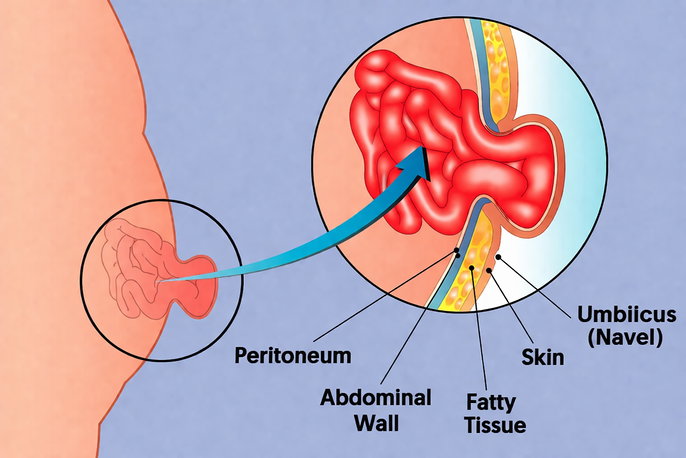
Epigastric hernia symptoms
The main symptoms of an epigastric hernia are:
-
A lump or swelling in the area above the navel, which may or may not be visible or felt. In some cases, it may only be noticed when coughing or lifting weight.
-
Pain and discomfort in the upper abdomen when coughing or lifting weight, in some cases.
As the hernia grows, part of the intestine may push through the abdominal wall. This can lead to intestinal obstruction or strangulation, which requires urgent surgery.
According to the American College of Surgeons and the NHS, a strangulated hernia is a surgical emergency that needs immediate treatment. In these cases, surgery is necessary to correct the problem.
Possible causes
An epigastric hernia occurs when a weak spot develops in the abdominal wall muscles. This weakening can be promoted by factors such as excess body weight, heavy manual work, or intense physical exertion.
Confirming a diagnosis
Diagnosis of an epigastric hernia is made by a primary care provider, who reviews the person's health history and performs a physical exam. During the exam, the person may be asked to stand up and cough to check whether a lump appears in the abdomen.
In addition, imaging tests such as ultrasound, computed tomography (CT), or magnetic resonance imaging (MRI) may be ordered to confirm the epigastric hernia, determine its severity, and guide the most appropriate treatment.
Treatment options
An epigastric hernia usually needs treatment when it causes symptoms, as this can help prevent complications.
Surgery may be done under local anesthesia when the hernia is small, or under general anesthesia. It involves placing the protruding tissues back into the abdominal cavity and may be performed using laparoscopy.
The doctor then closes the opening with stitches and may place a mesh in the area when the hernia is large. According to the American College of Surgeons, mesh is often used in abdominal wall hernia repairs and may reduce the risk that the hernia will come back.
Recovery from surgery is usually smooth and fairly quick, and most people can go home within one to two days. During this period, they should avoid physical strain and any intense activities.
The doctor may also prescribe pain relievers and anti-inflammatory medications to relieve pain after surgery.
Surgical risks
Surgery is generally well tolerated and usually causes only mild pain and bruising around the incision site. However, although rare, an infection may develop in the area, and in about 1% to 5% of cases, the hernia may come back.
