


- Enteral nutrition is used when oral intake is not enough and the gastrointestinal tract is still functional.
- It is delivered through a tube using customized or commercial formulas based on individual needs.
- Risks include digestive symptoms, aspiration, and tube complications, requiring careful monitoring.
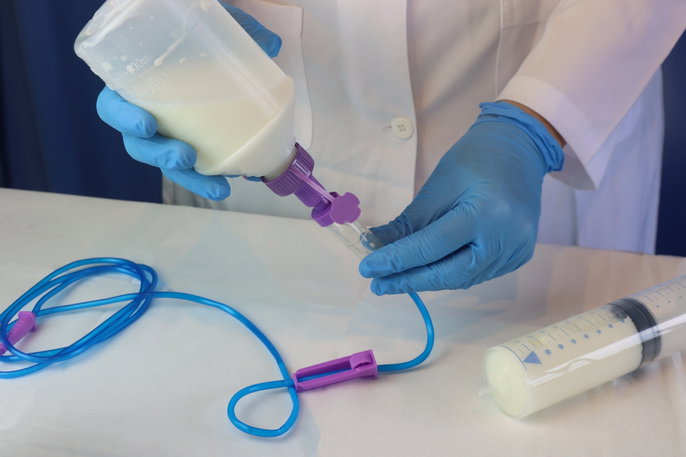
Enteral nutrition is a way of feeding that provides some or all of the nutrients a person needs. It is used for people who cannot meet their nutritional needs by eating and drinking normally.
This type of feeding is given through a tube that is usually placed through the nose or mouth and advanced into the stomach or intestine. It can also be given through a gastrostomy or jejunostomy.
There are different types of enteral nutrition, including homemade and commercial formulas. The most appropriate option should be chosen by a doctor or registered dietitian based on the person’s clinical condition, nutrition needs, type of device, and tube location.
Main indications
Enteral nutrition may be recommended in situations such as:
- Critically ill hospitalized patients, with feeding started within the first 24 to 48 hours of admission.
- Hospitalized patients who are at nutritional risk.
- People at home who cannot maintain adequate oral intake (≤ 60% of their nutritional needs), such as in cases of dysphagia due to neurological disease, heart disease, or gastrointestinal cancer.
- People who are malnourished or at high nutritional risk, with oral intake below 60% of their needs for 1 to 2 weeks.
- Older adults when oral feeding is contraindicated or when food intake has been inadequate for more than 3 consecutive days.
- Older adults who need a high amount of nutrients for recovery and are not meeting their needs by mouth, such as in wound healing, sarcopenia, major surgery, or burns.
- Older adults whose diet and oral supplements do not meet daily energy and protein requirements, or when extra calories are needed to improve quality of life.
- Older adults when oral feeding increases the risk of aspiration and aspiration pneumonia.
- People with cancer who cannot eat any food for more than 1 week, or who consume less than 60% of their daily needs for more than 2 weeks, even after dietary counseling and nutritional supplements.
- People with diabetes, when oral feeding is contraindicated or inadequate for 3 to 7 days, even with supplements. In these cases, enteral nutrition should be started within 24 to 48 hours.
- Older adults when oral intake is impossible, such as in severe injuries to the mouth, or after surgery involving the face and/or head and neck, complete gastrointestinal obstruction, or fistulas with major fluid loss.
According to the American Society for Parenteral and Enteral Nutrition (ASPEN), enteral nutrition is recommended for people who cannot meet their nutritional needs through oral intake alone, as long as the gastrointestinal tract is still partially or fully functional.
Enteral nutrition can also be introduced gradually as a transition from parenteral nutrition, as the person’s tolerance improves.
Enteral vs parenteral nutrition
Parenteral nutrition is a feeding method given through a vein, in which all or part of the nutrients are delivered directly into the bloodstream through a venous catheter.
This type of nutrition is indicated when the gastrointestinal tract (gut) cannot adequately absorb nutrients or when enteral feeding is contraindicated or not possible.
According to ASPEN, enteral nutrition is generally preferred when the gastrointestinal tract is functional because it delivers nutrients directly into the digestive tract and helps support intestinal integrity.
Main types
The types of enteral nutrition vary according to how they are prepared and their nutritional composition.
1. Types of enteral nutrition by preparation
The choice of enteral nutrition should be based on the person’s clinical condition, the setting where the therapy will be given, the need to ensure the prescribed nutrient intake, and reducing the risk of contamination.
2. Types of enteral nutrition by composition
Based on their composition, enteral nutrition types include:
-
Standard formulas (polymeric): these contain proteins, carbohydrates, fats, vitamins, and minerals, and may also contain dietary fiber, in line with recommendations for a healthy population.
-
Modified formulas (or specialized formulas): these have changes in composition, such as reduced, increased, or excluded nutrients, to meet specific needs related to metabolic changes or disease.
-
Nutritional modules: these are made up of just one nutrient group, such as a protein-only, carbohydrate-only, fat-only, or fiber-only module. They are used to adjust a diet that is lacking a specific nutrient.
-
Oligomeric or elemental formulas: these contain protein that has already been broken down into peptides or amino acids and are indicated for people with impaired digestion or intestinal absorption.
There are also immunomodulating formulas, which are enteral formulas enriched with specific nutrients such as arginine, omega-3, nucleotides, and glutamine. The goal of these formulas is to help regulate the inflammatory response, improve immune function, and support healing.
How to administer
Enteral nutrition can be given through a nasoenteric tube, nasogastric (NG) tube, or ostomy, such as a gastrostomy or jejunostomy, depending on the person’s clinical stability, the type of device, and the location of the tube.
Enteral nutrition may be given continuously, which is usually done over 12 to 24 hours with an infusion pump, or intermittently by gravity or bolus, which is usually divided into 4 to 6 feedings per day with at least three hours between feedings.
It may also be given in a cyclic schedule, where the feeding runs continuously during a fixed part of the day, such as 10 hours overnight.
Care instructions
Important precautions during enteral nutrition include:
-
In the hospital, checking the label for the person’s name, bed number, formula composition, volume, infusion rate, and expiration date, according to the medical or nutrition prescription
-
Confirming tube placement and patency before starting the feeding
-
Positioning the person with the head of the bed elevated to an angle of 30º to 45º during feeding and for 30 to 40 minutes afterward, to reduce the risk of reflux, regurgitation, and aspiration pneumonia
-
Flushing the device with at least 20 mL of filtered or mineral water before and after feeding to keep it open and help prevent clogging
-
Washing hands properly and disinfecting the tube and feeding set connections with 70% alcohol
-
Providing daily oral care to help reduce bacterial buildup and lower pneumonia risk
-
Not adding medications directly to enteral formulas, to avoid incompatibilities, tube blockage, or changes in how the medication works
It is also important for the medical team to watch for signs of gastrointestinal intolerance, such as abdominal bloating, nausea, and vomiting.
Potential side effects
Some side effects may occur during enteral nutrition, such as diarrhea, constipation, nausea, vomiting, and abdominal bloating.
There is also an increased risk of blood sugar fluctuations, especially hyperglycemia, gastrointestinal infections, aspiration, and aspiration pneumonia.
Complications related to the device may include tube blockage, erosion in the nostrils, sinusitis, skin irritation and ulcers, and tube displacement, which can lead to leakage of the formula into the abdominal cavity, severe peritonitis, and even risk of death.
Refeeding syndrome may also occur when nutrition is restarted too aggressively or too quickly in people with severe malnutrition or prolonged fasting.
Contraindications for use
Enteral nutrition is not indicated for people with severe hemodynamic and metabolic instability, such as uncontrolled shock, lactic acidosis, severe metabolic acidosis, and hypoxemia.
People with intestinal ischemia, bowel obstruction, short bowel syndrome, abdominal compartment syndrome, and uncontrolled upper gastrointestinal bleeding should also not receive this type of nutrition.
In addition, enteral nutrition is contraindicated for people with intolerance and gastric stasis, and in cases of high-output fistula when it is not possible to place the tube beyond the fistula
