


- Dermatomes map areas of skin sensation to specific spinal nerve roots, which helps explain why tingling or numbness often shows up in a predictable pattern.
- Myotomes map muscle movement to nerve roots, so weakness with actions like bending the arm or lifting the foot can point to where a nerve is affected.
- Seek urgent medical care for new or worsening weakness, numbness after an injury, or any loss of bladder or bowel control, as these can signal serious spinal cord or nerve compression.
Dermatomes are regions of skin supplied by sensory nerves that exit the spinal cord and transmit sensations from those areas to the brain. Myotomes, in turn, provide motor innervation to the muscles within the same corresponding regions.
The spinal column is made up of 33 vertebrae and has 31 pairs of nerves that are distributed throughout the body in an organized way. Each nerve that exits the spine is responsible for providing sensation and strength to a specific area of the body, so when there is compression or damage to a nerve, a specific area of the body can be affected.
Because of this organization, doctors can often identify which nerve root or segment of the spinal cord is involved when a person reports tingling, weakness, or difficulty moving a body part. For example, symptoms may show up in an arm or along the outer side of the foot depending on which nerve is affected.
In total, there are 31 dermatomes, which are divided into sections, as shown below:
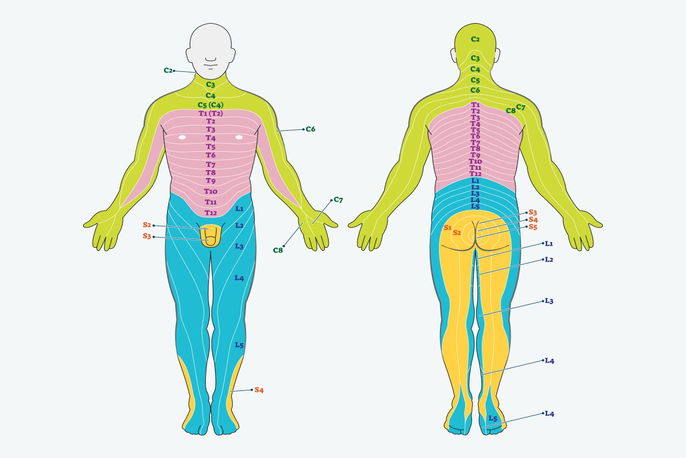
Map of dermatomes
Dermatomes are divided according to their path and innervation into:
-
Cervical dermatome: sensory innervation is provided by nerves from roots C2 to C8, which are responsible for sensation in the back of the head, neck, shoulders, arms, forearms, and hands. The C1 root, which is not present in all people, may provide sensitivity to a small central point at the back of the head;
-
Thoracic dermatome: sensory innervation is provided by nerves from roots T1 to T12, which generate sensitivity along the inner edge of the arm and forearm, as well as areas of the chest, abdomen, and back;
-
Lumbar dermatome: sensory innervation is provided by nerves from roots L1 to L5, which provide sensitivity to the lower back, lower abdomen, the front of the legs, and, to a greater extent, the feet, soles of the feet, and heels;
-
Sacral dermatome: sensory innervation is provided by nerves from roots S1 to S5, which provide sensitivity to the genital region, buttocks, the back of the legs, and a small area of the soles of the feet and heels.
The dermatome map is used by physicians and physical therapists to look for signs of changes or compression involving the spinal cord.
This is because when sensation changes in specific areas of the body, it can be easier to identify which part of the spine may be affected. This can happen due to trauma or a herniated disc, for example.
Dermatomes can also be referenced in alternative therapies, such as acupuncture or reflexology, to stimulate areas that correspond to specific nerve pathways.
Dermatomes vs myotomes
Dermatomes refer to areas of the skin where sensory nerves are found and are associated with sensation changes, such as tingling throughout the body.
Myotomes are responsible for muscle movement in that same region. Examples include flexion, extension, adduction, and abduction, depending on the location involved.
For example, numbness along the outer side of the foot usually indicates a spinal issue between the L5 and S1 vertebrae, since that region corresponds to the same dermatome.
But if a person has muscle weakness and trouble bending the arm, the affected region is more likely the cervical spine, specifically C6 and C7, because that region corresponds to that myotome.
The table below indicates the myotomes and the main associated movements:
In addition, the S4 and S5 segments are involved in controlling perianal movements and are located around the anus.
Dermatomes and the spine
As explained by the National Institute of Neurological Disorders and Stroke (NINDS), the spinal cord is a bundle of nerves and nerve fibers that transmits signals between the brain and the body.
Dermatomes are connected to the spinal column because the sensory nerves that form them originate in the spinal cord, which is housed within the spinal column.
These nerves pass through the vertebrae and branch out across the body, providing sensations of touch, temperature, and pain to specific regions of the skin. The route each nerve takes determines the area of skin associated with each dermatome.