


The vaginal ring is a contraceptive method that consists of a thin, flexible ring that is inserted into the vagina and releases hormones to inhibit ovulation. The vaginal ring is made of a soft plastic that fits the contours of the vagina and should not cause discomfort while in place.
The vaginal ring remains in the vagina for 3 weeks (21 days), after which it is removed and discarded. This is followed by an "off week", or ring-free period, in which the user goes without the ring for 1 week (7 days) before replacing it with a new one. When used correctly, the vaginal ring is 99% effective in preventing pregnancy.
The vaginal ring is a prescription-only medication that can be found at most pharmacies. It is sold under the brand name NuvaRing, among others. The vaginal ring is not recommended for everyone, including women who smoke and are over the age of 35.
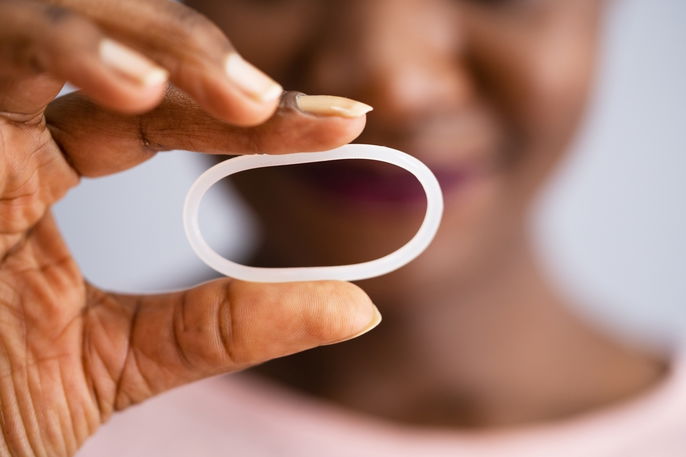
How it works
The vaginal ring is a flexible plastic ring that contains hormones similar to those found in birth control pills. After it is placed in the vagina, the ring releases these hormones, which are absorbed through the vaginal wall and act to inhibit ovulation and thicken the cervical mucus in order to prevent pregnancy.
Typically, the vaginal ring remains in place for 3 consecutive weeks (21 days), after which it is removed for 1 week (7 days) to allow for menstruation to occur. After 1 week, a new ring is placed.
How to insert
The following are step by step instructions on how to insert the vaginal ring:
- Check the expiration date on the package;
- Wash your hands before opening the package and removing the ring;
- Choose a comfortable position, such as standing with one foot up on a chair, or lying down;
- Hold the ring between your thumb and index finger, pinching the sides together to form the number 8;
- Insert the ring gently into the vagina and push it up as far as it will go.
The exact location of the ring is not important for it to function, therefore a person can position it in the vagina wherever it is most comfortable. The ring is removed by inserting the index finger into the vagina and pulling the ring gently out.
Ideally, the vaginal ring should be inserted during the first 5 days of your period. If not, it is recommended to avoid having sex or to use a backup method of birth control, like condoms, for the first 7 days after the ring is placed to decrease the risk for pregnancy.
When to replace
The vaginal ring needs to be removed after 3 weeks (21 days) of continuous use and remain out for 1 week, after which a new ring is placed. This works out to a new ring once every 4 weeks.
A practical way to remember this is: if you put the vaginal ring in on a Saturday at about 9 pm, you should remove it 3 weeks later, also on a Saturday at 9 pm. The new ring should be placed exactly one week later, on the next Saturday at 9 pm.
If the vaginal ring is removed during the 3-week period for more than 3 hours, it may be necessary to use a back up method, such as condoms, for 7 days after putting the ring back in.
Pros & Cons
The following table gives information on the advantages and disadvantages of using the vaginal ring:
The vaginal ring is one of many birth control options available on the market. It is important to talk to your OBGYN or other women's health provider to better understand the advantages and disadvantages of the vaginal ring and whether it is right for you.
What to do if the ring falls out
If the vaginal ring falls out, what to do depends on how long the ring is out of the vagina:
- Less than 3 hours: the ring should be washed with soap and water and then reinserted into the vagina. The ring continues to be effective in preventing pregnancy as long as it is not out for more than 3 hours, therefore a backup method of contraception is not necessary.
- More than 3 hours during weeks 1 or 2 of use: in this case, the effectiveness of the ring may be reduced. Therefore, in addition to washing and reinserting the ring into the vagina, a backup method, like condoms, should be used for 7 days. Unprotected sex during those 7 days could result in pregnancy.
- More than 3 hours during the 3rd week of use: in this case, the ring should be thrown out and replaced with a new ring either right away or after a 7 day break, being sure to follow the guidance of your OBGYN or prescribing provider. Use condoms until the new ring has been in for 7 days.
If you forget to insert a new ring after the 7 day break, be sure to insert it as soon as you remember and count 3 weeks from that day before removing it.
In this case, it is also important to use a backup method for 7 days in order to prevent pregnancy. Make sure to consult your provider if you had unprotected sex in the days prior to placing the new ring, as there is a risk for pregnancy if the ring was out for more than 7 days.
Side effects
Possible side effects of the vaginal ring include:
- Nausea;
- Vaginal irritation and/or discharge;
- Headache;
- Bleeding/spotting between periods;
- Weight gain;
- Breast sensitivity.
These side effects are typically mild and tend to resolve after a few months of using the ring.
Contraindications to use
The birth control ring should not be used by women who smoke and are over the age of 35; those with an increased risk for blood clots or a history of heart attack, deep venous thrombosis (DVT), or stroke; or during the first 6 weeks postpartum.
The vaginal ring is also contraindicated in people with high blood pressure, migraine with aura, severe liver disease, breast cancer, unexplained heavy vaginal bleeding, or an allergy to ethinyl estradiol or etonogestrel.
Frequently asked questions
-
The vaginal ring is a very effective method of contraception that inhibits ovulation. When used correctly, the chances of getting pregnant are less than 1%. However, if the ring is out of the vagina for more than 3 hours or is not replaced at the correct time, it is possible for ovulation to occur.
If this happens, it is necessary to use a backup method, like condoms, for 7 days after replacing the ring.
Read more: Type of Birth Control (9 Contraceptive Methods & Side Effects)
-
The vaginal ring becomes effective at protecting against pregnancy after 7 days of continuous use. It is important to use condoms for 7 days after putting in the first ring.
After this, the ring will protect against pregnancy, even during the week it is out, as long as it is 1) not out for more than 3 hours at a time during the 3 weeks it is supposed to be in, 2) left in for more than 4 weeks, or 3) left out for more than 7 days during the ring-free period.
The vaginal ring does not protect against sexually transmitted infections (STIs). It is therefore recommended that individuals with more than one sexual partner, or who are unsure of their partner's STI status, to use condoms every time they have sex.
-
No, you cannot keep the same ring in without changing it out. This is because after 4 weeks the amount of hormone released may not be enough to inhibit ovulation, increasing the risk for pregnancy if you have sex without a condom.
If you wish to skip your period, however, it is possible to remove the ring 3-4 weeks after placing it and insert a new one right away, with no break in between. Before doing this, it is important to talk to your OBGYN or prescribing provider for more detailed information.