


- Urinary catheters drain urine from the bladder when urination isn’t possible or needs to be closely monitored, including before or after certain procedures.
- Indwelling catheters stay in place for continuous drainage, while intermittent catheters are inserted briefly and removed once the bladder is emptied.
- Catheter use can raise the risk of UTIs, bleeding, and urinary tract injury, so proper technique and only using it when needed are important.
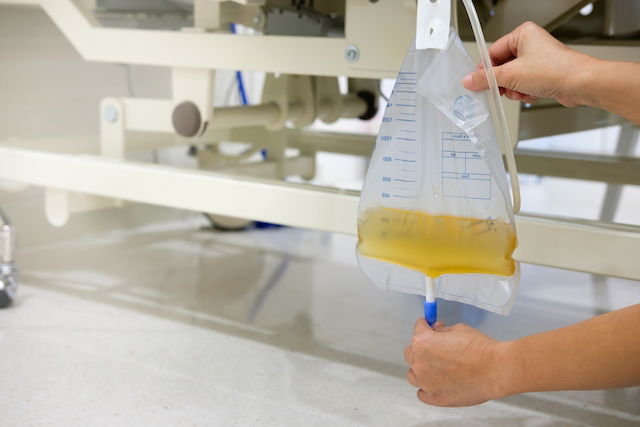
A urinary catheter is a thin, flexible tube inserted through the urethra into the bladder so urine can drain into a collection bag. It is generally used when someone cannot control urination due to an obstruction, such as an enlarged prostate or urethral narrowing/widening, or when sterile urine is needed for testing or to prepare for surgery.
Because catheter insertion carries real risks of infection, injury, and bleeding, it should only be performed when absolutely necessary and, whenever possible, by a trained healthcare professional.
In some situations, catheterization can be done at home, but only after proper instruction and supervised training with a nurse. Using the correct technique is essential to reduce complications.
Indications for use
Because of the risks, a urinary catheter should only be used when it is clearly needed, such as in the following situations:
-
Relief of acute or chronic urinary retention;
-
Monitoring urine output from the kidneys;
-
Post-renal kidney failure due to an obstruction below the bladder;
-
Collection of sterile urine for testing;
-
Measurement of post-void residual volume;
-
Management of urinary incontinence;
-
Ureteral dilation;
-
Assessment of lower urinary tract function;
-
Emptying the bladder before, during, and after surgeries and exams;
In addition, a urinary catheter may also be placed to deliver medications directly into the bladder in cases of severe infections, for example.
Main types
There are two types of bladder catheterization:
1. Indwelling urinary catheter
An indwelling urinary catheter is used when continuous drainage is needed for several days, weeks, or months.
This type of catheter may be used to keep the bladder continuously emptied, monitor urine output, prepare for surgery, perform bladder irrigation, or reduce contact between urine and skin wounds near the genital area.
2. Intermittent or straight (in-and-out) urinary catheter
Unlike an indwelling catheter, an intermittent catheter is not left in place for long and is usually removed once the bladder is emptied.
This type of catheter is often used to drain urine before a medical procedure or to provide quick relief for people with paralysis and chronic urinary retention, for example. It may also be used in people with neurogenic bladder to collect a sterile urine sample or to measure residual urine after the bladder has been emptied.
Insertion steps
According to the Centers for Disease Control and Prevention (CDC), urinary catheters should be inserted using aseptic technique and by properly trained persons to help prevent catheter-associated urinary tract infections (CAUTI)
Urinary catheter insertion usually involves the following steps:
- Gather all necessary materials;
- Put on gloves and clean the person’s genital area;
- Wash hands;
- Open the catheterization kit next to the person using sterile technique;
- Open the catheter package and place it next to the tray without contaminating it;
- Apply lubricant to one of the gauze pads from the kit;
- Ask the person to lie on their back, with legs apart for females and legs together for males;
- Put on the sterile gloves from the catheterization kit;
- Lubricate the tip of the catheter;
- For females, clean the area using forceps with gauze, gently separating the inner labia with the thumb and index finger, then wiping with antiseptic-moistened gauze between the outer and inner labia and over the urinary opening;
- For males, use forceps with gauze moistened in antiseptic to clean the glans. With the thumb and index finger of the left hand, gently retract the foreskin to expose and clean the urinary opening;
- Hold the catheter with the hand that did not touch the genital area and insert it into the urethra, keeping the other end inside the tray and checking for urine flow;
- Inflate the catheter balloon with 10 to 20 mL of distilled water.
At the end of the procedure, the catheter is secured to the skin with tape. In men, the tape is placed on the lower abdomen (suprapubic area), and in women it is placed on the inner thigh.
Possible risks
Based on CDC CAUTI prevention recommendations, urinary catheters should be used only for appropriate indications and left in place only as long as needed to reduce infection risk.
Other risks include bleeding, bladder stone formation, and injuries to the urinary tract, most often related to using excessive force during catheter insertion or handling.