


- A urinalysis checks urine for signs of urinary tract infections, kidney problems, inflammation, or changes in overall health.
- It is usually done with a clean-catch midstream urine sample collected at a doctor’s office, clinic, or laboratory.
- A urine culture or 24-hour urine test may be needed when more specific information is required.
A urinalysis (UA) is a common test used to detect signs of problems in the urinary tract and kidneys, such as infection, inflammation, or impaired kidney function. It is performed using a urine sample, usually collected as a clean-catch midstream specimen.
A urine sample is usually collected at a doctor’s office, clinic, or laboratory and does not require fasting. In some cases, a first morning urine sample may be requested because it is more concentrated.
A urinalysis is one of the most commonly ordered lab tests because it is simple, painless, and can provide useful information about overall health. Other urine tests include the 24-hour urine test and the urine culture, which can help detect bacteria or fungi in the urine.
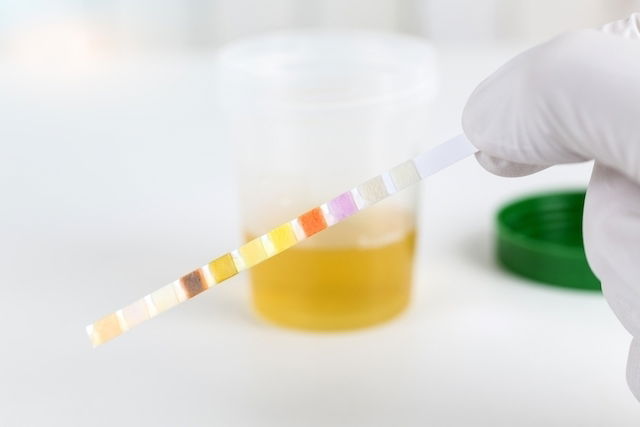
Why a urinalysis is ordered
A urinalysis is used to:
-
Assess a person’s overall health
-
Identify urinary tract infections (UTIs) and kidney problems
-
Monitor diseases and response to treatment
A urinalysis may be ordered with other lab tests, such as blood urea and creatinine levels, a complete blood count (CBC), and C-reactive protein (CRP), for example.
24-hour urine test
A 24-hour urine test measures how the urine changes over an entire day. It is done by collecting all urine passed in 24 hours in a large container.
After collection, the urine is taken to the laboratory, where tests are performed to assess its volume and chemical composition. This can help detect kidney filtration problems, loss of protein in the urine, and conditions such as preeclampsia during pregnancy.
What a urinalysis checks
A routine urinalysis evaluates the following:
-
Physical aspects: color, specific gravity, and appearance
-
Chemical aspects: pH, nitrites, glucose, proteins, ketones, bilirubin, and urobilinogen
-
Abnormal elements: blood, bacteria, fungi, protozoa, sperm cells, mucus threads, casts, and crystals
During urinalysis, sediment analysis is also performed to check for the presence and amount of white blood cells and epithelial cells in the urine.
Reference values
Reference values for urinalysis can vary by laboratory, but commonly include:
- pH: about 4.5 to 8.0
- Specific gravity: 1.005 to 1.030
- Characteristics: no glucose, proteins, ketones, bilirubin, blood, or nitrites, with normal or low amounts of urobilinogen, few white blood cells, and rare epithelial cells
If a urinalysis shows positive nitrites, blood, and many white blood cells, for example, this may suggest a urinary tract infection (UTI).
According to the National Institute of Diabetes and Digestive and Kidney Diseases, urinalysis can check for blood and white blood cells in the urine, while a urine culture can identify common types of bacteria and help determine whether antibiotics may be needed. A urinalysis should not be used by itself to diagnose a urinary problem.
Ascorbic acid in urine
Ascorbic acid, or vitamin C, may also be checked in urine to see whether it could interfere with results for hemoglobin, glucose, nitrites, bilirubin, and ketones, for example.
Increased ascorbic acid in urine may be due to vitamin C supplements or eating large amounts of vitamin C foods.
How to prepare for a urinalysis
In general, no special preparation is needed before a urinalysis. However, your healthcare provider may recommend avoiding certain medications or supplements, such as high-dose vitamin C supplements, before the test because they can affect the results.
It is also important to collect the urine sample correctly. Not collecting a clean-catch midstream sample or not cleaning the genital area properly before collection can affect the results.
People who menstruate are generally advised to avoid having a urinalysis during their period whenever possible, as menstrual blood may affect the results.
Urine test to detect pregnancy
A urine pregnancy test detects pregnancy by measuring hCG, a hormone found in urine. This test is reliable, but the result may be wrong if it is taken too early or not done correctly.
The best time to take a urine pregnancy test is starting on the first day after a missed period. It should be done with the first urine of the morning, as hCG is usually more concentrated at this time.
According to the U.S. Food and Drug Administration (FDA), false-negative pregnancy test results can occur, including when testing is done during a very early stage of pregnancy or when urine is too diluted. In this case, a new test should be done after 1 week.