


- Scintigraphy is a nuclear medicine test used to create detailed images of organs, tissues, bones, and blood or air flow.
- It may be used to diagnose or monitor conditions such as cardiac ischemia, pulmonary embolism, thyroid cancer, and kidney problems.
- It is not recommended during pregnancy or for people allergic to the radioactive tracer used.
Scintigraphy is a nuclear medicine imaging test that uses radiopharmaceuticals, such as technetium or gallium, to create detailed images of organs, tissues, and bones. These images help doctors evaluate function, structure, and blood or air flow.
This test can help diagnose and/or monitor the treatment of several conditions, such as cardiac ischemia, bone infections, pulmonary embolism, thyroid cancer, dementia, renovascular hypertension, and pyelonephritis. It may also be used to assess different organs after a transplant.
Scintigraphy is performed by a radiologist. The images are captured by a gamma camera and sent to a computer, where they are recorded and analyzed by the doctor.
Why it's done
Scintigraphy may be recommended to evaluate organ, tissue, bone, blood flow, or air flow abnormalities. According to the National Institute of Biomedical Imaging and Bioengineering, scintigraphy uses radioactive molecules to help assess how organs and tissues are functioning.
Scintigraphy may be recommended for:
-
Inflammatory diseases or infections
-
Cancer in the bones, thyroid, kidneys, or brain, or metastases
-
Pyelonephritis, renovascular hypertension, or urinary flow blockage
-
Pulmonary embolism or pulmonary hypertension
-
Stroke, Alzheimer’s disease, or Parkinson’s disease
-
Cardiac ischemia
In addition, scintigraphy may be recommended to monitor the kidneys, lungs, or heart after a transplant.
How to prepare
Scintigraphy usually does not require special preparation or fasting. However, depending on the type of scintigraphy, the doctor may recommend eating light meals or avoiding foods that contain iodine.
Let the doctor know about all medications you are taking and any allergies you may have. Based on guidance from the International Atomic Energy Agency, it is also important to tell the doctor if you are pregnant, might be pregnant, or are breastfeeding before a nuclear medicine exam.
On the day of the test, it is recommended to bring any previous test results.
What to expect
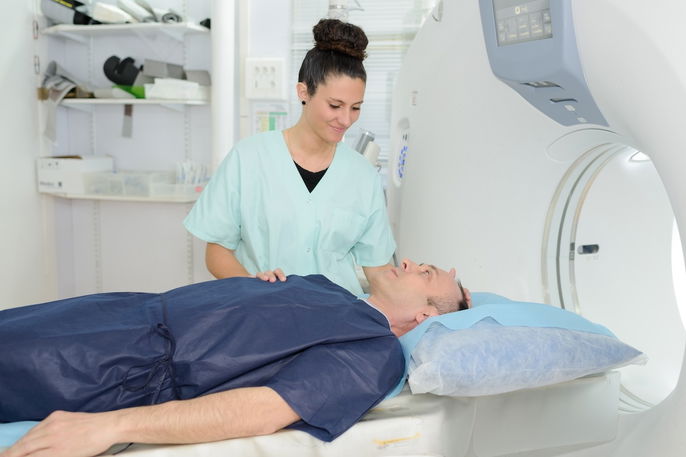
Scintigraphy is performed by a radiologist while the person lies on an exam table. It is important to avoid moving, as movement can affect the images.
To perform scintigraphy, the doctor follows these steps:
-
Administers the radioactive tracer into a vein or ask the person to inhale an aerosol or drink the tracer
-
Asks the person to lie on the imaging table
-
Positions the gamma camera over the area being examined
-
Obtains the images, which are captured and recorded on a computer
If the radiopharmaceutical was injected into a vein, the IV line is removed after the test.
After the scintigraphy test, the person is allowed to go home.
How long does it take?
How long a scintigraphy test takes depends on the type being performed. Bone, renal, or lung scintigraphy usually takes about 30 to 40 minutes.
Thyroid scintigraphy may take about 2 hours.
Main types
The main types of scintigraphy are:
1. Bone scintigraphy
Bone scintigraphy is usually done to evaluate the cause of bone pain and diagnose bone problems, such as cancer, bone metastases, osteomyelitis, osteomalacia, or Paget’s disease, for example.
In this type of scintigraphy, the radiopharmaceutical, such as technetium or gallium, is injected into a vein and builds up in areas with high bone activity.
2. Myocardial scintigraphy
Myocardial scintigraphy, or cardiac scintigraphy, is done to evaluate the cause of chest pain and identify changes in blood flow through the arteries of the heart during rest and physical exertion.
Therefore, heart scintigraphy is used to assess the risk of heart disease and diagnose heart failure or heart valve disease.
In addition, this type of scintigraphy may be done after a heart transplant to check perfusion, which is the blood flow in the transplanted heart.
3. Renal scintigraphy
Renal scintigraphy is generally recommended when a urine test shows abnormalities, to assess for infections, inflammation, or blockages in the urinary tract.
This type of scintigraphy can help diagnose renovascular hypertension, pyelonephritis, kidney cancer, or changes in kidney anatomy, for example.
4. Thyroid scintigraphy
Thyroid scintigraphy is recommended to evaluate thyroid function. It allows the doctor to detect thyroid nodules or thyroid cancer, inflammation, Graves’ disease, or investigate the causes of hyperthyroidism and hypothyroidism, for example.
5. Pulmonary scintigraphy
Pulmonary scintigraphy is done to evaluate blood and air flow in the lungs. It is generally recommended to diagnose pulmonary embolism or pulmonary hypertension.
In addition, ventilation-perfusion lung scintigraphy may be done before lung cancer surgery or after a lung transplant, for example.
6. Cerebral scintigraphy
Cerebral scintigraphy is usually recommended to detect changes in blood circulation and brain function.
This type of scintigraphy allows the doctor to identify or monitor the treatment of conditions such as Alzheimer’s disease or Parkinson’s disease, brain cancer or brain metastases, stroke, or herpetic encephalitis, for example.
7. Hepatobiliary scintigraphy
Hepatobiliary scintigraphy is recommended to evaluate the liver, gallbladder, bile ducts, and small intestine, and to identify blockages or obstructions in the gallbladder, liver function problems, or inflammation.
This type of scintigraphy can help diagnose cholecystitis, cirrhosis, biliary dyskinesia, or biliary atresia in infants, for example.
Potential risks
Scintigraphy is a safe test with few risks. However, pain, redness, or inflammation may occur at the site where the radioactive tracer is injected into the vein.
In addition, allergic reactions to the radiopharmaceutical may occur. These reactions are treated immediately by the doctor.
Contraindications for the test
Scintigraphy is contraindicated during pregnancy because radiopharmaceuticals and radiation are used during the test.
In addition, scintigraphy is contraindicated if the person is allergic to the radioactive tracer used in the test.