


- Seek urgent care for a red spot on the eye with vision changes, severe pain, light sensitivity, or eye discharge.
- Schedule an ophthalmology visit if the spot grows, keeps coming back, or does not start improving within a few days.
- Get prompt medical evaluation after eye trauma, or if redness occurs with fever, swelling, or symptoms of infection (especially in babies).
A red spot on the eye is a common finding and may appear suddenly due to irritation, a small scratch, or an allergic reaction. In many cases, it is linked to fragile blood vessels on the surface of the eye that can break easily.
A common cause of a red spot on the eye is a subconjunctival hemorrhage, which happens when a small blood vessel breaks after coughing, sneezing, straining, or rubbing the eyes. Other causes include episcleritis, pterygium, or irritation from substances like makeup, dust, or shampoo.
Depending on the cause, a red spot on the eye may resolve on its own or require treatment such as cold compresses, lubricating eye drops, or prescription medication. Medical evaluation is important when the redness is painful, affects vision, increases in size, or does not improve over time.
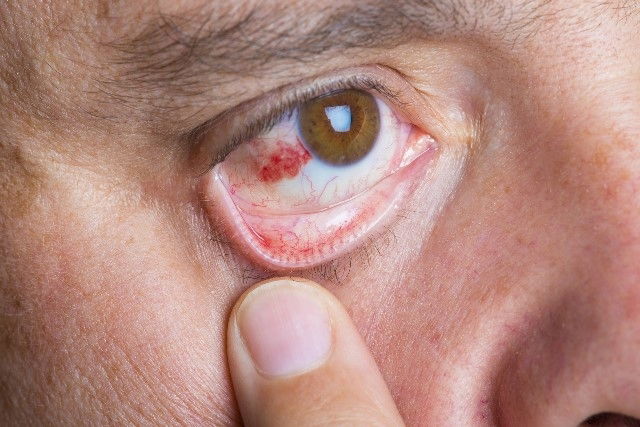
Why is there a red spot on my eye?
The most common causes of a red spot on the the eye include:
1. Scratch to the eye
The eye can become irritated or scratched from vigorous rubbing or when a foreign object enters it. The conjunctiva (the thin membrane covering the eyeball) contains delicate blood vessels that can easily break.
What to do: To relieve eye irritation, you can apply cold compresses to the affected eye and use moisturizing eye drops. If the pain is severe or doesn’t improve, or if the spot keeps growing, you should see an ophthalmologist to check how deep the lesion is.
2. Allergic reaction
An allergic reaction may be triggered by dust, mites, mold, or chemicals in products like makeup or shampoo. It can cause eye redness that is widespread or limited to one area and may result in conjunctivitis.
The red spot may occur with itching, burning, tearing, or eyelid swelling. If sneezing and eye itching are also present, the redness may be due to an environmental allergy.
What to do: Avoid contact with the trigger, rinse your eyes with clean water, and use lubricating or antihistamine eye drops. If symptoms last more than 2 days, see an ophthalmologist for further evaluation.
3. Subconjunctival hemorrhage
This occurs when a small blood vessel on the eye’s surface breaks, causing a red patch or bruise.
Common triggers include eye rubbing or itching, straining, vomiting, infections of the eye or eyelid, or recent eye surgery.
What to do: According to the American Academy of Ophthalmology, a subconjunctival hemorrhage typically heals on its own without treatment over a few days to a few weeks. You can apply cold compresses to the eyes twice a day and use artificial tears to speed up recovery and reduce discomfort.
If the redness does not improve within a few days, or if it causes pain or vision changes, you should consult an ophthalmologist.
4. Episcleritis
Episcleritis is inflammation of the thin layer covering the white of the eye and surrounding the cornea, often causing a red spot. In some cases, a small movable lump called an episcleral nodule may appear on the eye.
This is a benign condition, and its exact cause is not yet fully understood. However, it appears to be linked to autoimmune diseases, rheumatic disorders, or infections such as syphilis or herpes.
What to do: Episcleritis usually clears on its own within 1 to 2 weeks. Treatment may include cold compresses and artificial tears for comfort. If needed, the ophthalmologist can prescribe anti-inflammatory medication or antibiotics.
5. Pterygium
Pterygium is a membrane-like growth that extends over the cornea, forming fibrous tissue and sometimes blood vessels. It often appears red and may cause discomfort, redness, itching, or vision changes.
The condition is linked to excessive sun exposure and genetic factors.
What to do: The ophthalmologist may recommend artificial tear eye drops to ease discomfort. Protect your eyes from the sun with sunglasses and hats. If tissue overgrowth affects vision or appearance, it can be surgically removed.
Red spot on baby’s eye
A red spot on a baby’s eye may result from a small subconjunctival hemorrhage caused by straining during a bowel movement, coughing, or sneezing. It can also occur from vigorous rubbing. This is usually harmless and often fades within 2 to 3 weeks.
However, if the redness does not clear up or is accompanied by symptoms such as fever or eye discharge, it should be evaluated by a pediatrician, as it could indicate an infection like pink eye.
Based on the Centers for Disease Control and Prevention (CDC), pink eye in babies commonly causes eye redness with discharge and swelling, which warrant medical evaluation especially when fever is present.