


Myopia, or nearsightedness, is a vision problem that makes it hard to see things clearly at a distance. It can cause blurry distance vision, frequent headaches, eye pain, squinting, and tired eyes after activities like reading.
This condition happens when the eyeball is longer than normal or when light focuses in front of the retina instead of directly on it. Because of this, distant objects appear blurry, and an eye exam with an ophthalmologist (eye doctor) is important for proper evaluation.
In general, the degree of myopia tends to increase over time and may stabilize between ages 18 and 30. Glasses and contact lenses help correct blurred vision, but they do not cure myopia, and in some cases the doctor may recommend laser surgery.
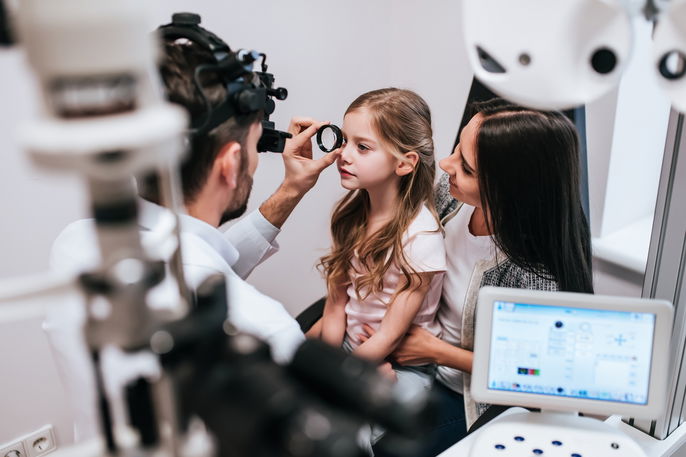
Common symptoms
The main symptoms of myopia are:
-
Difficulty seeing things at a distance
-
Frequent headaches
-
Constant eye pain
-
Needing to squint to try to see more clearly
-
Writing with the face very close to the desk
-
Difficulty reading the board at school
-
Not being able to see road signs from far away
-
Excessive tiredness after driving or reading, for example
Symptoms of myopia can start in childhood, usually around age 8, and may get worse during adolescence.
Symptoms of degenerative myopia
The first symptoms of degenerative myopia include eyes that appear more prominent, poor distance vision even with glasses or contact lenses, a permanently enlarged pupil, dark areas in the vision, flashing lights, or black spots in the field of vision.
Without proper treatment, this condition can progress quickly and, in more severe cases, may lead to permanent vision loss.
Confirming a diagnosis
Myopia is diagnosed by an ophthalmologist (eye doctor) with a visual acuity test, which uses letter charts and other tests to evaluate how well a person can see at different distances. According to the National Eye Institute, this type of eye exam helps determine whether a person has myopia or another refractive error
This exam also helps identify the degree of myopia. In general, myopia is considered mild when it is up to 3 diopters, moderate when it is between 3 and 6 diopters, and severe when it is above 6 diopters.
Possible causes
Myopia may be caused by genetic factors or influenced by habits and health conditions, such as low lighting, long periods of reading, certain medications, diabetes, and prolonged focusing.
It may also be linked to maternal factors, including older maternal age and smoking during pregnancy.
Main types
Based on the changes observed in the eye and their underlying cause, myopia can be classified into the following types:
-
Axial myopia: happens when the eyeball is longer than normal. It usually causes higher degrees of myopia.
-
Curvature myopia: is the most common type and happens when the cornea or lens becomes more curved, causing images to form before reaching the correct point on the retina.
-
Congenital myopia: happens when a baby is born with eye changes that cause a high degree of myopia that remains throughout life.
-
Secondary myopia: may be associated with other conditions, such as nuclear cataracts, which can cause degeneration of the lens after trauma or glaucoma surgery, for example.
When the eye is shorter than normal, another vision condition called hyperopia can occur, causing images to focus behind the retina.
Treatment options
Treatment for myopia should be recommended by an ophthalmologist based on the severity of the condition. In most cases, glasses or contact lenses with spherical lenses are used to help focus light correctly onto the retina, improving vision.
However, if glasses or contact lenses are not enough and the condition continues to worsen over time, myopia surgery may be recommended. It is usually considered after age 18, when the prescription has become more stable. According to the National Eye Institute, eyeglasses, contact lenses, and refractive surgery are among the main treatment options for myopia.
