


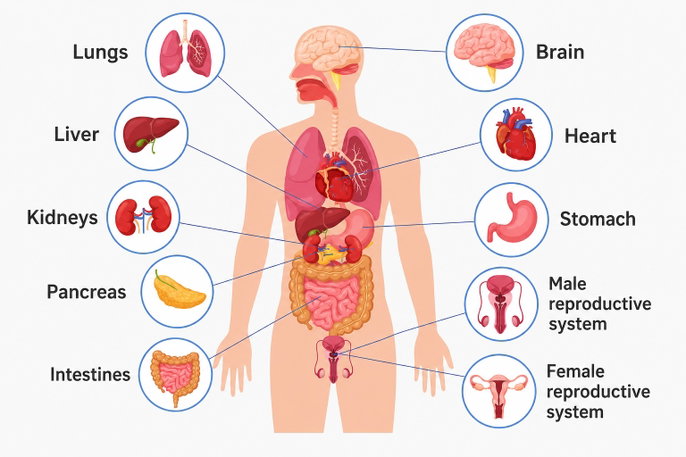
Human body organs include the heart, esophagus, stomach, small and large intestines, liver, brain, spinal cord, kidneys, bladder, lungs, and gonads. These organs help the body function properly every day.
Each organ has specific roles, such as helping digest food, absorb nutrients, remove toxins, support reproduction, and control movement. Together, they allow the body’s systems to work in a coordinated way.
Human body organs are grouped into systems based on their function. These include the digestive, nervous, circulatory, respiratory, urinary, and reproductive systems.
Organs of the digestive system
The main organs of the digestive system are:
1. Oral cavity
The teeth grind food into smaller pieces, while saliva moistens it and starts its chemical breakdown, forming a soft mass called a food bolus.
The tongue contains taste buds, which allow you to taste food. It also pushes food toward the throat, while a small tissue called the epiglottis folds over the trachea to prevent choking and allow food to pass into the esophagus.
Possible signs of a problem: Pain or burning that makes chewing difficult, as well as reduced taste. These problems may be caused by canker sores, ulcers, tongue abnormalities, taste bud problems, cheilitis, or erosive lesions.
Older adults who lose their teeth may also have trouble chewing food properly, difficulty with digestion, and a higher risk of choking.
2. Pharynx and salivary glands
The salivary glands, such as the parotid, submandibular, and sublingual glands, produce saliva. Saliva contains enzymes, such as amylase, lingual lipase, lysozymes, and others, that help trigger chemical digestion.
The pharynx is a passage shared with the respiratory system. It allows the food bolus to move from the mouth to the esophagus.
Possible signs of a problem: Dry mouth, swelling below the jaw, or pain in the upper neck when swallowing.
3. Esophagus
The esophagus is an organ in the neck and chest that carries food from the mouth to the stomach. It is mostly made of muscles that contract during swallowing to help push food down.
Possible signs of a problem: Difficulty or pain when swallowing, a burning feeling in the throat, and frequent choking may be signs of esophageal problems, such as achalasia or gastroesophageal reflux.
4. Stomach
The stomach is a hollow organ located near the center of the upper abdomen.
Its main function is to digest food by producing gastric juice. This fluid contains enzymes that break down food and destroy most microorganisms that are swallowed.
Possible signs of a problem: Burning in the abdomen, feeling full quickly even after small meals, and excessive burping may indicate stomach problems, such as heartburn, stomach ulcer, or gastritis.
5. Liver
The liver is located in the abdomen, mostly under the ribs on the right side. It helps metabolize proteins, carbohydrates, hormones, and foreign substances in the body, and it produces bile, a fluid involved in food digestion.
The liver also helps filter and store blood, produce clotting factors, and store iron and vitamins.
Possible signs of a problem: Liver disease symptoms may include pain under the right rib cage, yellowing of the skin or eyes, abdominal swelling, and pale stools.
6. Gallbladder
The gallbladder is a hollow, pear-shaped organ located just below the liver. It is connected to the liver, pancreas, and small intestine through ducts known as bile ducts.
The main function of the gallbladder is to store bile and release it into the small intestine during digestion.
Possible signs of a problem: Nausea and pain below the ribs on the right side, especially after large or high-fat meals.
7. Pancreas
The pancreas is located in the abdomen, just below the stomach. It is a gland that secretes pancreatic juice, a mixture of enzymes and sodium bicarbonate that is released into the small intestine to help digest food.
The pancreas also produces hormones, such as insulin and glucagon, which are released into the blood and help control glucose levels.
Possible signs of a problem: Diarrhea, upper abdominal pain that extends to the back, and changes in blood glucose levels may indicate problems with the pancreas.
8. Small and large intestines
The small intestine is an abdominal organ divided into the duodenum, jejunum, and ileum. It receives partially digested food from the stomach, along with bile and pancreatic juice, to continue digestion.
The large intestine is connected to the small intestine and receives the remaining material from digestion. It is divided into the cecum, colon, rectum, and anus. The colon includes the ascending, transverse, descending, and sigmoid colon.
The main function of the small intestine is to absorb nutrients into the bloodstream. The large intestine mainly absorbs remaining nutrients and water from digestion and helps form stool.
Possible signs of a problem: Abdominal swelling, diarrhea, pain that spreads across the abdomen, nausea, vomiting, excess gas, and blood in the stool.
If digestive system problems are suspected, it is recommended to consult your primary care provider or a gastroenterologist.
Organs of the respiratory system
The main organs of the respiratory system are:
1. Nose and nasal cavities
The nose and nasal cavities are the entry point for air into the human body. They filter impurities through nasal hairs and warm and humidify the air before it reaches the lungs.
Possible signs of a problem: Stuffy nose, loss of smell, nosebleeds, or excessive nasal discharge.
2. Larynx
The larynx is an organ in the neck that measures about 2 inches long. It is part of the airway and connects the throat to the trachea and lungs.
The main functions of the larynx include producing speech and helping prevent food from entering the lungs during swallowing.
Possible signs of a problem: Hoarseness, shortness of breath, noisy breathing, and choking are common symptoms that may indicate problems with the larynx.
3. Trachea
The trachea is an organ that extends through the neck and chest. It is mainly made of cartilage, has a tube-like shape, and connects the larynx to the lungs.
Its main function is to carry air to the lungs, which are the final part of the airway.
Possible signs of a problem: Cough, trouble breathing, and noisy breathing may indicate problems with the trachea, such as tracheitis or airway obstruction.
4. Bronchi
The bronchi are the two tubes that branch from the trachea and enter the lungs. They divide into smaller tubes called bronchioles to distribute air throughout the lungs.
Possible signs of a problem: Cough with phlegm, wheezing when breathing, and chest tightness.
5. Lungs
The human body has two lungs, located inside the rib cage on each side of the body.
The lungs are responsible for gas exchange. According to the National Heart, Lung, and Blood Institute (NHLBI), they absorb oxygen into the bloodstream and remove carbon dioxide from the body.
Possible signs of a problem: Cough, shortness of breath, rapid breathing, wheezing, and tiredness.
If respiratory system changes are suspected, it is recommended to consult a pulmonologist.
Organs of the urinary system
The main organs of the urinary system are:
1. Kidneys
There are two kidneys, one on each side of the body, located in the lower abdomen. These organs filter the blood and remove excess water and other substances from the body through urine.
The kidneys also help regulate blood pressure and produce erythropoietin, a hormone that stimulates the formation of new red blood cells.
Possible signs of a problem: The main symptoms of kidney problems include increased or decreased urination, back pain, swelling in the body, foamy urine, and tiredness.
2. Ureters and urethra
The ureters are two thin tubes that carry urine from the kidneys to the bladder. The urethra is the final tube that allows urine to leave the body.
Possible signs of a problem: Severe side pain that radiates to the groin, also called renal colic, burning when urinating, or a weak urine stream.
3. Bladder
The bladder is a triangular organ in the lower abdomen that is connected to the kidneys through the ureters.
This organ receives and stores urine produced by the kidneys and then releases it through the urethra.
Possible signs of a problem: Lower abdominal pain, blood in the urine, and an urgent or frequent need to urinate are examples of symptoms that may indicate bladder problems.
If urinary system problems are suspected, it is recommended to see a urologist. For kidney-related conditions, a nephrologist may also be recommended.
Nervous system organs
The main organs of the nervous system are:
1. Brain
The brain is made up of cells called neurons and includes the cerebral hemispheres, cerebellum, and brainstem.
This organ is responsible for functions such as body movement, senses, emotions, language, thinking, and memory.
The brain also coordinates the function of other organs. For example, it helps regulate breathing, digestion, and swallowing through the autonomic nervous system.
Possible signs of a problem: Muscle weakness, loss of coordination, confusion, tremors, and difficulty with reasoning or memory may indicate a stroke or Alzheimer’s disease, for example.
2. Spinal cord
The spinal cord begins at the lower part of the brainstem and extends through the inside of the spine.
Its function is to carry nerve impulses from the brain to the rest of the body through several nerves.
Possible signs of a problem: Muscle weakness, decreased muscle tone, and urinary incontinence may indicate problems with the spinal cord.
If nervous system problems are suspected, it is recommended to consult a neurologist.
Organs of the circulatory system
The main organs of the circulatory system are:
1. Heart
The heart is the main organ of the circulatory system and is responsible for pumping blood through the blood vessels. According to the American Heart Association (AHA), the heart also works continuously to circulate oxygen- and nutrient-rich blood throughout the body.
Possible signs of a problem: Heart disease symptoms may include an irregular heartbeat, chest pain that worsens with exertion and may spread to the left arm, shoulder, or neck, and leg swelling.
2. Blood vessels
Blood vessels form a network that carries blood between the heart and the organs. This allows oxygen and nutrients to reach the body’s tissues, while carbon dioxide and other waste products are carried away to be eliminated by the kidneys, liver, and lungs.
Possible signs of a problem: Depending on the affected blood vessels, symptoms may include localized pain, cramps, muscle fatigue, and skin wounds.
If cardiovascular problems are suspected, it is recommended to consult a cardiologist.
3. Spleen
The spleen is located in the upper left abdomen, behind the stomach. Its main function is to filter the blood by removing old or damaged red blood cells, and it also acts as a reservoir for blood and platelets.
It also plays a role in the immune system by producing lymphocytes to fight infections.
Possible signs of a problem: Pain below the ribs on the left side that may radiate to the shoulder, feeling full quickly after meals due to an enlarged spleen, and weakness or dizziness in cases of rupture or bleeding.
Organs of the musculoskeletal system
The organs of the musculoskeletal system are:
1. Bones
Bones provide the body with a rigid structure and protect delicate internal organs. They contain bone marrow, where blood cells are formed, and they also store the body’s calcium reserves.
Bones connect to each other and form joints, giving the body a strong and mobile skeleton. Bone and joint integrity and function are supported by joint cartilage, ligaments, and bursae.
Possible signs of a problem: Pain, weakness, fractures, or bone deformities are some symptoms of bone problems, such as osteopenia, osteoporosis, Paget’s disease, rickets, cancer, and infections.
2. Muscles
There are three types of muscles: skeletal muscle, smooth muscle, and cardiac muscle. Skeletal and smooth muscles are part of the musculoskeletal system, while cardiac muscle is part of the circulatory system.
Skeletal muscles contract to move different parts of the body and are made up of bundles of contractile fibers. These muscles support posture and movement, and they are attached to bones and arranged in opposing groups around the joints.
Smooth muscles control body functions that are not under conscious control. They line many arteries and contract to regulate blood flow, and they also line the intestines and contract to move food and stool through the digestive tract.
Possible signs of a problem: Weakness, pain, cramps, or even paralysis may be caused by injuries, inflammation, nerve problems, muscular dystrophy, or certain medications.
3. Tendons and bursae
Tendons are strong bands of connective tissue made mainly of a firm protein called collagen. They firmly attach each end of a muscle to a bone.
Synovial bursae are small, fluid-filled sacs located under the tendons. They cushion tendon movement, help prevent injuries, and provide extra cushioning to nearby structures, preventing wear between a bone and a ligament, for example.
Possible signs of a problem: Pain, stiffness, swelling, or joint tenderness are symptoms that may be related to bursitis or tendinitis.
4. Ligaments
Ligaments are strong, fibrous bands made of connective tissue containing collagen and elastic fibers, which allow them to stretch to a certain point. Ligaments surround the joints and connect them to each other.
Ligaments help strengthen and stabilize the joints, allowing movement only in certain directions. They also connect bones to each other, such as inside the knee.
Possible signs of a problem: Inability to continue an activity, swelling, loss of range of motion, and a loud pop in the knee may be related to ligament injuries caused by tears or sprains, most often affecting the anterior cruciate ligament (ACL) of the knee.
5. Joints
Joint components help provide stability and reduce the risk of injuries that may result from constant use.
In a joint, the ends of the bones are covered by cartilage, a smooth, strong, elastic protective tissue made of collagen, water, and proteoglycans. Cartilage reduces friction during joint movement.
Joints also contain synovial tissue, which produces a small amount of clear fluid called synovial fluid. This fluid nourishes the cartilage and further reduces friction, making movement easier.
Possible signs of a problem: Joint pain and swelling, lack of flexibility, and immobility may be associated with conditions such as osteoarthritis or lupus.
Organs of the reproductive system
The main organs of the reproductive system are:
1. Gonads
In women, the gonads are the ovaries, which are two organs located in the pelvis. In men, the gonads are the testicles, which are also two organs and are located in the scrotum.
These organs produce sex hormones, such as estrogen, progesterone, and testosterone.
The ovaries contain eggs, while sperm are produced in the testicles.
Possible signs of a problem: Infertility, delayed or early development of sexual characteristics, such as hair growth or breast development, menstrual irregularities, and low libido.
2. Vagina and penis
The vagina is an organ of the female reproductive system. It allows menstrual blood to leave the body and helps protect the body against invasion by microorganisms, in addition to its reproductive function.
The penis is an organ of the male reproductive system with reproductive and urinary functions.
Possible signs of a problem: Sores, itching, yellow discharge or pain in the genitals, difficulty urinating, and pain during sex may indicate problems with the genital organs.
3. Uterus
The uterus is a female reproductive organ located in the pelvis. It is where a fertilized egg implants and where the fetus is protected during pregnancy.
The uterus is also responsible for menstruation.
Possible signs of a problem: Vaginal bleeding outside the menstrual period, prolonged or heavy periods, very short menstrual cycles, and difficulty getting pregnant.
If reproductive issues are suspected, it is recommended to consult a gynecologist for female reproductive concerns and a urologist for male reproductive concerns.
4. Fallopian tubes
The Fallopian tubes connect the ovaries to the uterine cavity. They serve as a passageway for the egg and as the site of fertilization.
Possible signs of a problem: Acute pelvic pain, irregular periods, or cysts detected by ultrasound.
5. Prostate and testicles
The prostate produces part of the seminal fluid that protects the sperm, which are produced in the testicles.
Possible signs of a problem: Difficulty starting urination, frequent urination at night, or testicular pain.
Organs of the integumentary system
The main organ of the integumentary system is the skin, which is the largest organ in the body.
The integumentary system acts as a protective barrier against the external environment, regulates body temperature, and enables the sense of touch.
Possible signs of a problem: Skin rashes, changes in the color or size of moles, persistent itching, dryness, spots of different colors, peeling, or wounds that do not heal.
Organs on the left and right side of the body
Some organs in the human body are primarily located on one side or the other, as shown in the table below.
If you have ongoing discomfort on either side of your body, see a healthcare professional for a proper evaluation.
