


The treatment for plantar warts usually involves applying salicylic acid or undergoing cryotherapy. In some cases, you might even be able to do this at home under the guidance of a dermatologist. It can take weeks or even a few months to see results.
There are other options, such as surgical removal or laser treatment of the plantar wart, but these tend to be less preferred. That’s because they carry a higher risk of pain, scarring, and the wart coming back. For those reasons, treatments like bleomycin injections may sometimes be recommended.
Also recommended: Plantar Warts: Symptoms, Causes & How to Get Rid of Them tuasaude.com/en/plantar-wartsEven though plantar warts often improve on their own (within up to two years), treatment may be needed in certain cases. That’s why it’s important to see a dermatologist for evaluation and, if needed, start the most appropriate treatment in a timely manner.
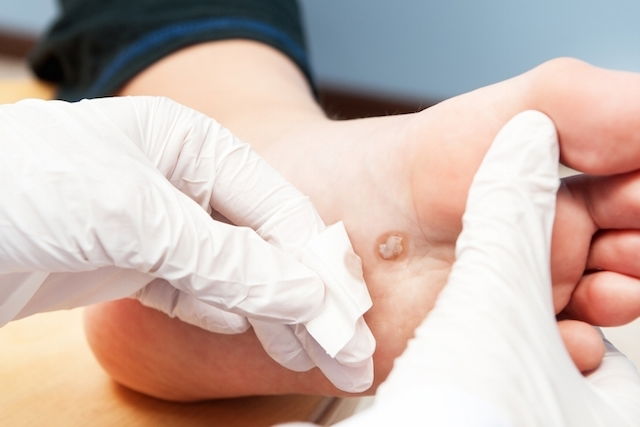
7 ways to get rid of plantar warts
Here are the main treatment options for removing plantar warts:
1. Salicylic acid
Salicylic acid is a keratolytic agent that, when applied to the wart, works by gradually stripping away the layers of skin and thereby destroying the wart. Solutions with salicylic acid can be used at home by the person or in a dermatologist’s office. Treatment time can stretch from weeks to months.
If you have a chronic condition that affects foot sensitivity (like poorly controlled diabetes or diabetic neuropathy) it’s recommended that you consult a dermatologist before starting this treatment.
2. Bleomycin injection
Bleomycin is a substance with antitumor properties that is often used when plantar warts have lasted for more than six months. In this treatment, the dermatologist injects bleomycin directly into the wart in the office, and several applications may be needed until the wart disappears.
Bleomycin injections can cause darkening of the skin and pain at the site, and they are not recommended for children, pregnant women, or people with conditions like uncontrolled diabetes or HIV. Bleomycin is FDA-approved for certain cancers but not specifically FDA-approved for wart removal; however, dermatologists may use it off-label for plantar warts, which is considered acceptable and common.
3. Cryotherapy with liquid nitrogen
Cryotherapy uses liquid nitrogen to freeze the cells of the wart, which gradually destroys the plantar wart. Compared to salicylic acid, cryotherapy tends to be less effective and often has more side-effects such as pain and skin discoloration. Still, it is frequently used, often in combination with other treatments. Typically, a dermatologist administers applications every 2–3 weeks over about 3 months.
4. Surgical removal
Surgical removal is done in the dermatologist’s office and may involve scraping (curettage), cauterization, or excising the skin where the lesion is located. While this method can work in some cases, it carries risks of pain, scarring, and possible recurrence of the wart.
5. Laser therapy
In laser therapy for plantar warts, a laser is applied directly to the wart to destroy its blood vessels, which leads to wart elimination. Though the wart may disappear, this option may bring side-effects like delayed healing, scarring, and postoperative pain.
6. Adhesive tape
Though not proven definitively effective, covering a plantar wart with adhesive tape is believed by some to help eliminate it. The idea is that the tape causes mild irritation where it’s applied, which may stimulate the immune system to clear the wart naturally.
7. Cantharidin application
Applying cantharidin is another option that can be performed by a dermatologist in the office. This medication causes the plantar wart cells to break down, forming a blister that helps the wart detach and be eliminated.
Although cantharidin can be effective, it is not FDA-approved for general over-the-counter use. In the United States, it is available only for professional, in-office application through compounded formulations, meaning it must be applied by a trained healthcare provider and is not sold directly to the public.
Home treatment for plantar warts
At home, some people use treatments like tea tree oil applied over the plantar wart. This remedy has antiviral properties and may serve to complement what your dermatologist recommends. However, this should not replace professional medical advice or prescribed treatment.
Check-out other home remedies for warts that you can try at home.