


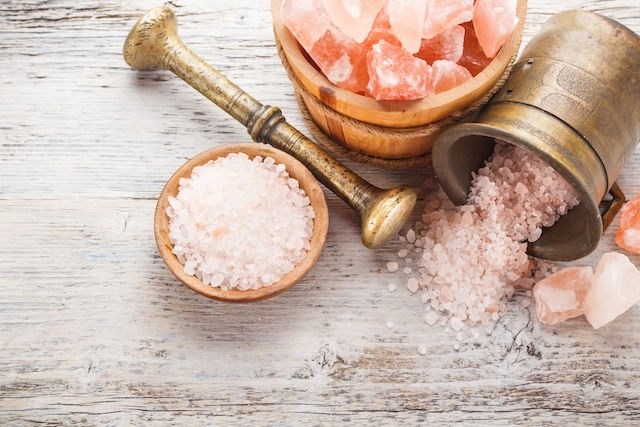
Himalayan salt is a type of salt that is characterized by its natural pink color. It is is not processed and contains no additives, which is why it is considered to be more natural than regular table salt.
This type of salt is manually extracted from salt mines located near the Himalayas, in Pakistan. It contains minerals such as calcium, potassium, magnesium, iron and zinc.
Like regular table salt, Himalayan salt is high in sodium, and should therefore be consumed in moderation, especially by those with high blood pressure or kidney disease.
Health benefits
Himalayan salt can offer possible health benefits like lowering the body's pH, treating skin conditions (like psoriasis) and some respiratory conditions (like asthma, bronchitis and coughing). However, these health benefits have not yet been scientifically proven, and more studies are needed on this salt.
This type of salt is contains minerals such as calcium, potassium, magnesium, iron and zinc. However, one scientific study mentions that consuming 1 teaspoon (5 g) of Himalayan salt per day does not provide significant amounts of these minerals, and that it does not offer significant health benefits.
Is Himalayan salt better for people with high blood pressure?
Himalayan salt contains less sodium than regular table salt, so it may be beneficial for people with high blood pressure.
However, a scientific study showed that there were no significant differences in blood pressure between the consumption of Himalayan salt and regular salt. Therefore, the general recommendation for patients with hypertension is to consume this salt in moderation.
Difference between Himalayan salt and table salt
Regular table salt goes through a refining and bleaching process, where many minerals are also removed. However it remains rich in sodium chloride. In addition, this type of salt also contains anti-humectants to give it a finer and looser texture.
Like table salt, Himalayan salt is also high in sodium chloride. However, because it is less processed, it still retains other minerals like calcium, potassium and magnesium.
How to use
Because it has a milder flavor than regular salt, Himalayan salt can be used to season fish, seafood, vegetables and leafy greens.
It has a more mild flavor, which is why some people tend to add more of it to their dishes. Therefore, you should avoid excessive use, and mix it with natural seasonings, like garlic, onion, parsley, chives and oregano.
Himalayan salt should be consumed in small portions, since 1 teaspoon (5 g) provides 1.9 mg of sodium, and the daily recommendation for this mineral, according to the World Health Organization, is less than 2 g per day.