


- A clavicle fracture can cause severe shoulder pain, swelling, deformity, bruising, and difficulty lifting the arm.
- It is commonly caused by falls, direct blows to the shoulder, contact sports, or car, motorcycle, and bicycle accidents.
- Treatment may involve pain-relieving medication, cold compresses, arm immobilization, physical therapy, or surgery in more severe cases.
A clavicle fracture is usually caused by a direct blow to the shoulder, such as from a fall or a car, motorcycle, or bicycle accident. It may cause symptoms such as shoulder deformity, severe pain, swelling, and difficulty lifting the arm.
The clavicle (or collarbone) is the bone that connects the arm to the trunk of the body. It helps support the weight of the arm and protects the nerves and blood vessels that supply the arm.
A broken collarbone is one of the most common types of fractures. Treatment is guided by an orthopedic doctor and may include pain-relieving medications, arm immobilization with a sling, physical therapy, or, in some cases, surgery.
Main symptoms
The main symptoms of a clavicle fracture are:
-
A cracking or popping sound when the clavicle breaks
-
Severe pain
-
Swelling at the fracture site
-
Difficulty moving or lifting the arm
-
Deformity in the area, such as a shoulder that appears dropped or pushed forward
-
A bump under the skin at the fracture site
-
Increased tenderness at the site and bruising, in some cases
If you suspect a clavicle fracture, avoid trying to move the bone back into place, as this can worsen the injury or harm nearby nerves or blood vessels.
It is important to go to the emergency room right away so the fracture can be diagnosed and the most appropriate treatment can be started.
Confirming a diagnosis
A broken clavicle is usually diagnosed in the emergency room or urgent care by a healthcare provider through an evaluation of symptoms, a physical exam, and a history of trauma, accidents, or falls.
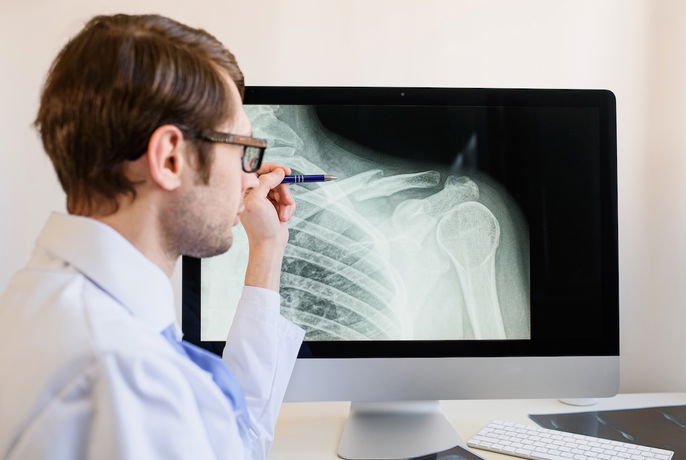
To confirm the diagnosis, the provider will order an X-ray, which can identify the location, type, and severity of the fracture, as well as whether any other bones are broken. According to the American Academy of Orthopaedic Surgeons, X-rays can also help determine how far the broken bone pieces have moved out of place.
The provider may also order a CT scan, MRI, or ultrasound to check for possible damage to blood vessels, muscles, ligaments, or nerves, and to help plan surgery if needed.
Possible causes
A broken clavicle may be caused by:
-
Direct impact to the clavicle, such as falling onto the shoulder or an outstretched arm
-
Blows to the shoulder during contact sports
-
Car, motorcycle, or bicycle accidents
A clavicle fracture can also occur in a baby during birth while passing through the birth canal.
Main types
The main types of clavicle fracture are:
-
Comminuted fracture: the bone breaks into several pieces, and surgery is usually needed
-
Transverse fracture: this type is easier to heal and usually only requires immobilization
-
Oblique fracture: depending on the angle, surgery may be needed
A clavicle fracture can also be classified according to the area of the bone affected, such as a medial, middle, or lateral third fracture. A middle third fracture, which occurs in the center of the bone, is the most common type.
Treatment options
The main treatments for a broken clavicle are:
1. Medications
Anti-inflammatory medications or pain relievers, such as acetaminophen or ibuprofen, may be recommended by a healthcare provider to relieve pain and discomfort from a clavicle fracture.
Other medications that may be prescribed include opioids, which are stronger pain relievers. These may be recommended by the provider for very severe pain or pain that does not improve with common pain relievers, and should only be used for a short period of time.
2. Cold compresses
Applying cold compresses to the area for 2 to 3 days after a clavicle fracture can help reduce swelling and relieve pain.
To make a cold compress, place ice in an ice pack or chill a gel pack in the freezer. Then wrap it in a clean, dry towel and apply it to the shoulder for 15 to 20 minutes, 3 to 4 times per day.
3. Immobilization
Immobilizing the arm with a sling or figure-of-eight brace helps keep the clavicle in the correct position. According to the American Academy of Orthopaedic Surgeons, many clavicle fractures can be treated with a sling to limit arm and shoulder movement while the bone heals.
Immobilization should be maintained for about 6 to 12 weeks in adults, or 3 to 6 weeks in children.
4. Physical therapy
Physical therapy for a broken clavicle aims to reduce pain, restore normal shoulder movement without pain, and strengthen the muscles until the person can perform daily activities normally.
To guide treatment, the physical therapist will assess whether the fracture has healed, the presence of pain, the degree of movement limitation, and any difficulties the person is experiencing. Based on this evaluation, an appropriate treatment plan will be recommended.
After about 12 weeks, higher-resistance exercises and shoulder stability training are usually recommended until full recovery.
5. Surgery
In some cases, a doctor may recommend surgery for a clavicle fracture, such as when there is bone displacement, bone shortening of more than 2 cm between bone fragments, an open fracture, or a risk of injury to a nerve or artery.
Although recovery time can vary from person to person, physical therapy sessions may be needed to restore normal movement of the affected arm and improve pain.
Potential complications
A clavicle fracture can cause some complications, such as nerve injury, formation of a bone callus, or delayed healing. These complications may be prevented when the bone is properly immobilized.
Care during recovery
Some precautions are important to help speed recovery and prevent complications, including:
-
Avoid activities that can move the arm for 4 to 6 weeks, such as cycling or running.
-
Avoid lifting the arm.
-
Do not drive while the bone is still healing.
-
Use the arm immobilizer as recommended, both during the day and at night.
-
Sleep on your back with the immobilizer, if possible, or sleep with the arm alongside the body and supported by pillows
-
Wear loose clothing that is easy to put on, as well as slip-on shoes
-
Move the shoulder, elbow, wrist, and hand as directed by the orthopedic doctor to prevent joint stiffness
In addition, to reduce pain during recovery, your healthcare provider may prescribe pain relievers and anti-inflammatory medications, which should be used to help improve symptoms.
