


Calisthenics are bodyweight exercises that strengthen muscles, improve flexibility, and increase endurance without requiring gym equipment. This form of training can also enhance body awareness and mobility, making it a complete approach to fitness.
The main benefits of calisthenics include muscle growth, fat loss, and improved balance and coordination. Because it can be practiced anywhere, calisthenics are easy to adapt to routines like functional training, gymnastics, or crossfit.
Common calisthenics exercises include squats, push-ups, planks, and pull-ups, which target multiple muscle groups at once. When performed correctly, these exercises provide a safe, effective, and versatile full-body workout.
Health benefits
The main health benefits of calisthenics are:
- Increased flexibility and joint mobility
- Increased resistance and muscular strength
- Greater body awareness
- Increase in muscle mass
- Activation of metabolism
- Increased energy expenditure and decreased fat percentage
- Development of motor coordination
- Improved balance
Because calisthenics does not require gym equipment, this type of training can be carried out in any environment, which can keep it exciting.
Calisthenics exercises
The following exercises can be added to a workout routine that targets the full body. They target muscles in the legs, abdomen, arms, back and chest, and are particularly recommended for those who are starting calisthenics-based workouts for the first time.
You can repeat these calisthenics up to 3 times, resting 30 to 60 seconds between each exercise., and four minutes between each set.
1. Wall sitting
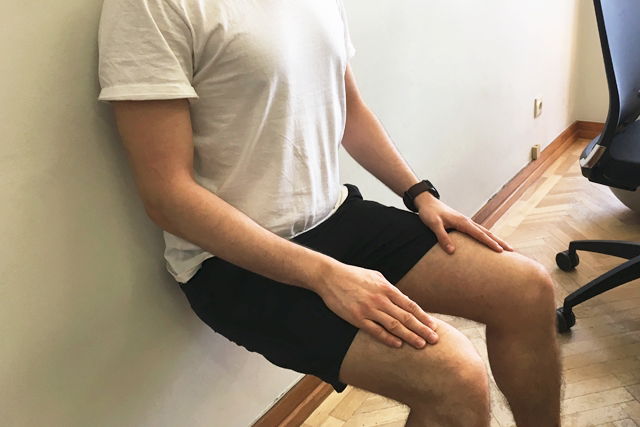
To perform this exercise, stand against a wall, and then place both feet about 60 cm from the wall,without removing your back and glutes from the wall. In this position, slide your glutes down the wall until your knees are at a 90º angle. Hold this position for about 30 seconds.
This exercise is similar to the squat, and mainly works the gluteal and thigh muscles without causing stress on the knees. It is a good option for those with injuries to this joint.
2. Squats
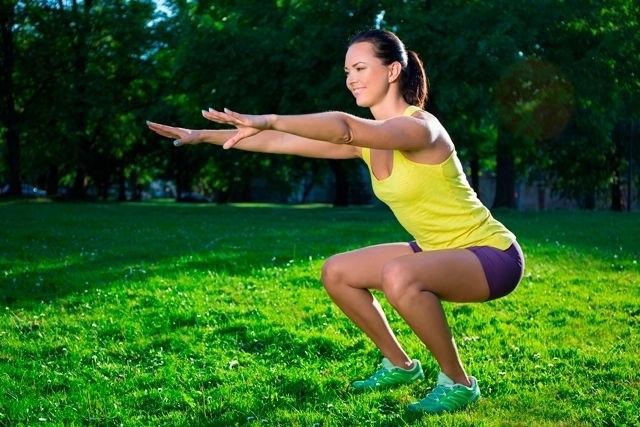
Squats are a common exercise and are great for working almost all of the leg muscles and glutes. To perform a squat correctly, stand with your feet shoulder-width apart, then squat with your glutes sitting back until your knees are at 90º. Then return to the starting position, keeping your knees slightly flexed.
Repeat this exercise 8 to 12 times in each set. One way to intensify the exercise is to hold a weight in front of the body and/or to lower yourself slowly.
3. Pull-ups
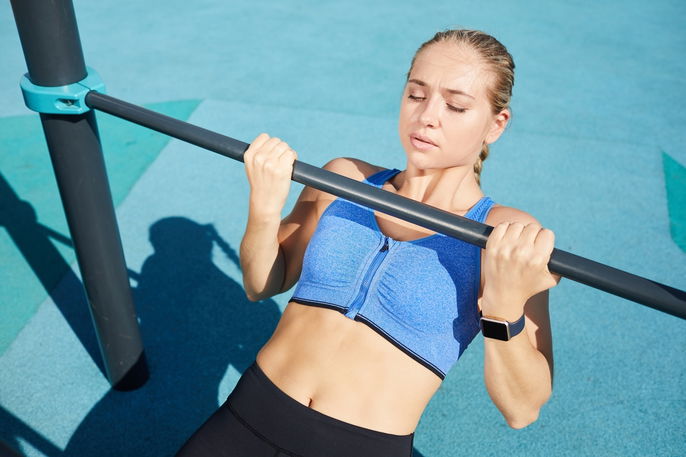
A pull-up is a great exercise for strengthening the chest, back and shoulders, and can be done with a low or high bar. The low bar pull-down, which is close to the hip height, is beneficial for beginners, as it is possible to maintain contact with the floor throughout the exercise.
To perform the low bar pull-down, the person must hold the bar at shoulder width apart and position the body under the body, with your legs straight in front of you or semi-flexed. Then, pull your body, upward trying to get your head above the bar.
Another more advanced pull option is using the high bar, in which you jump up to grab the bar, taking your feet completely off the ground. Place their hands slightly wider than shoulder-width apart, and pull the body upwards until the bar comes close to your chin. Perform this movement 3 to 5 times. Initially, you can do the exercise with the help of an elastic band, which must be attached to the bar. "Step" into the elastic band to help with the upward movement.
4. Tricep dips
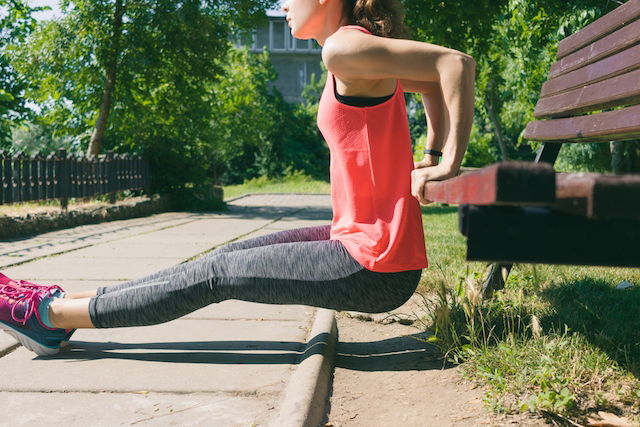
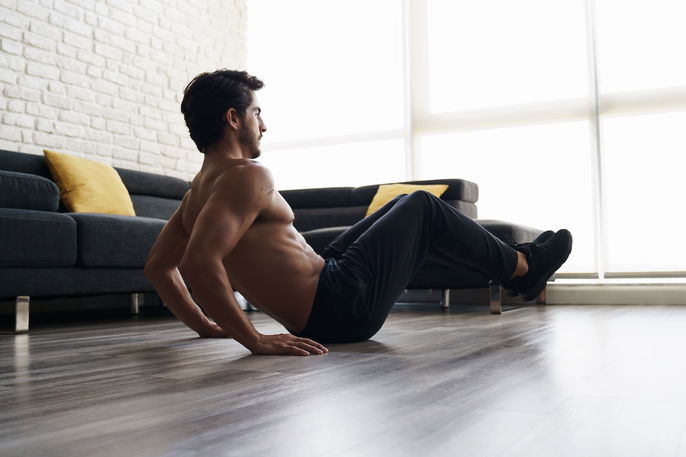
To do triceps extensions or dips on a bench, rest both hands on a bench or chair and bring your buttocks to the edge of the seat. Stretch your legs in front of you, bending them slightly, and bring your feet together. Bend your legs slightly in front of the body, bring your feet together and point them upwards. Then lower your body from the bench, keeping your hands behind you, until your elbows are at a 90º angle, then raise your body back up.
To make the movement more difficult, keep your legs extended, as this will require more force to perform the exercise.
5. Push-ups
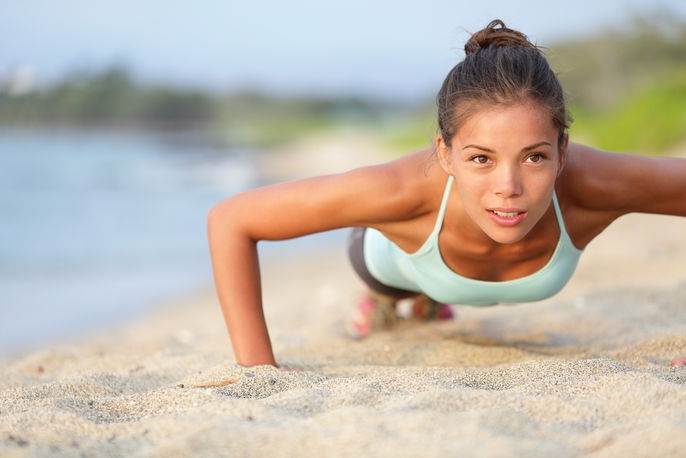
To do a push-up, lie on the floor on your stomach and place your hands under your shoulders. Then, raise your body from the floor in a plank position, and lower your body until your elbows are at a 90º angle.
Initially, it is possible to perform the exercise with your knees resting on the floor and, and progress to your feet as you get a better feel for the exercise.
During the entire exercise it is very important to keep your abdominal muscles contracted to keep your body completely straight and to prevent back injuries. This exercise is great for strengthening your arms and back, as well as your chest.
6. Crunches
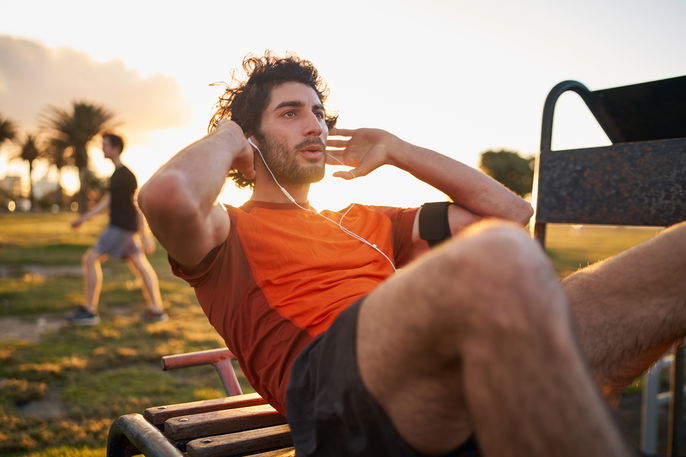
Crunches are done by lying on the floor, with your legs bent. Brace your core to lift the upper back off the floor.
Another abdominal exercise for beginners is the jacknife crunch, whicih involves lying down straight on your back with your arms straight above your head. Brace your core, then raise your knees to your chest and hug them before stretching out, back to the starting position and repeating.
As you become stronger, you can train your abs using two parallel bars. With one hand on each bar, lift your body from the floor, keeping your arms straight. Then lift your knees to your chest and lower again. Repeat 8 to 10 times.
One way to increase the difficulty is to keep your legs straight and to raise them, without bending your knees.
7. Plank
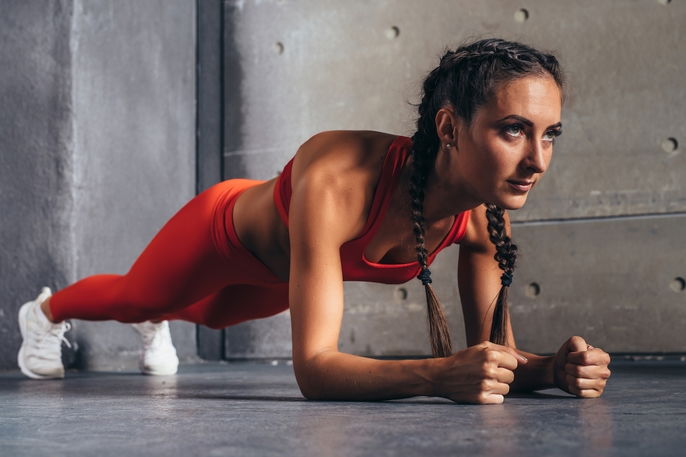
A plank is also an exercise that can be included in the calisthenics workout routine for beginners. To do this exercise, lie down and support their body weight on their hands, or forearms, and feet. Hold this position for 30 to 60 seconds, while keeping your abdominal muscles contracted.
It is also possible to add plank variations to your routine, like a side plank or side plank crunches to increase difficulty.
8. Lunge
The lunge is an effective exercise for strengthening the core and lower body, especially the glutes and thighs. It is also a popular movement to add to calisthenics training routines.
To perform a lunge, start standing and take a long step forward with one leg. Bend both knees and lower the hips, then return to the starting position. Repeat the movement, alternating legs.
9. Burpee
The burpee may not be the simplest exercise, but it is an excellent option for a beginner calisthenics workout when looking for more of a challenge. This movement combines squats, planks, and push-ups in one sequence.
To do a burpee, start standing and squat down, placing your hands on the floor. With a small jump, kick your legs back into a plank position. Perform a push-up, then jump the legs forward into a squat position, and finish with a jump to return to standing before repeating the sequence.