


Calf exercises help strengthen the lower leg and support better stability for walking, running, and daily movements. These exercises can target both the gastrocnemius and soleus muscles, which are responsible for leg shape, power, and balance.
Different types of calf exercises, such as standing, seated, isolated, and step variations, activate the muscles in specific ways. Training can be done several times per week, using slow, controlled movements and a full range of motion to improve strength and definition.
Proper technique is important to prevent pain or injury, especially when using weights or increasing intensity. If calf pain, swelling, or weakness persists despite regular training, a doctor or physical therapist may recommend evaluation, imaging tests, or guided rehabilitation.
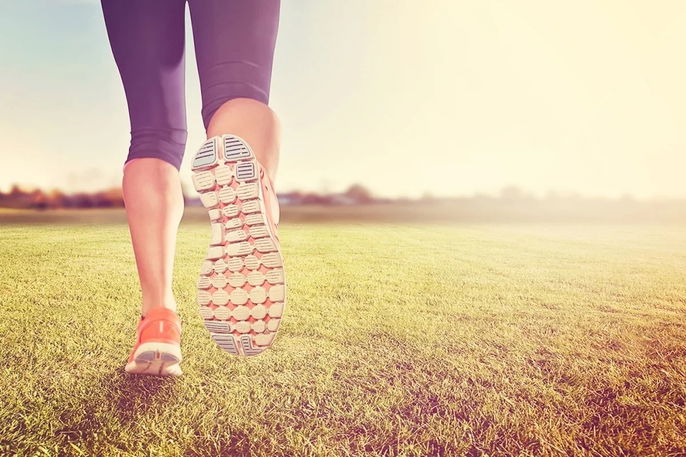
Calf muscles
To achieve optimal calf results, you should incorporate exercises that work the two calf muscles:
- Soleus muscle: This muscle is underneath and in the innermost part of the calf, and it is associated with the greatest volume. This is the shortest muscle in the calf and is most worked by exercises that are performed while sitting.
- Gastrocnemius muscle: This is the most superficial muscle that is divided into two parts, which give the calf its well-known shape. This is the longest muscle in the calf and is best worked when doing exercises while standing.
Since the calf muscles are positioned differently and connect in different locations, their development will depend on different exercises. The calf is a small muscle and takes less time to recover. Therefore it can be trained up to 3 times a week.
List of calf exercises
Some exercises that can be done that work the calf muscles are:
1. Standing calf raise
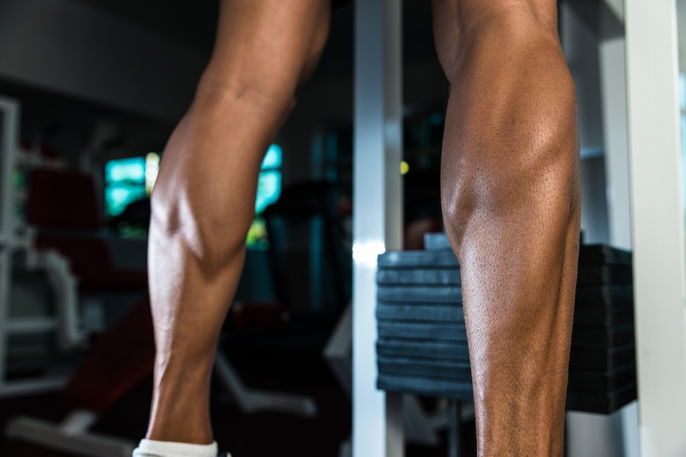
This exercise is the most commonly performed, especially by beginners, as it is simple and is normally used as a way of getting the muscle used to movement. In this type of exercise, simply lean on a wall or a bench, stand up on your toes and slowly lower to the starting position.
To intensify this move, you can put put on shin guards, as this will create greater resistance and make the movement harder.
2. Calf raises on the step
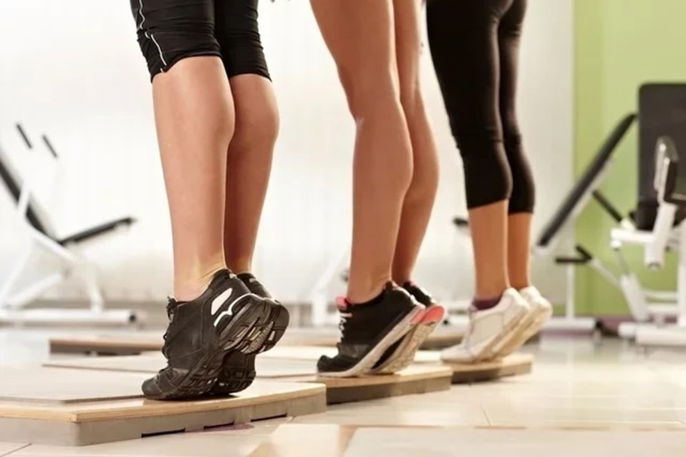
This exercise is a variation of the movement above, but it is done with greater intensity to develop a calf with greater volume and more strength. It targets mainly the gastrocnemius muscle. In this type of exercise, the weight does not matter, but rather the range of movement: the greater the range, the greater the work of the calf muscle.
To do this exercise, you should:
- Step onto an exercise step or bench.
- Keep only the toes on the ledge of the step, keeping the heel unsupported;
- Get up on your toes and stretch your calf, pushing your body upwards. Use as much force as possible, as if you were going to jump, but without taking your feet off the step.
- Lower down, letting your heels pass slightly below the level of the step to stretch the muscle.
It is very important to carry out the last step of the exercise correctly, as it allows you to work the muscles in their entirety. When in the lowered position, maintain it for at least 1 second, before rising again, to ensure that the energy accumulated on the tendon has time to dissipate, only working the muscle.
Also recommended: Leg Workout: 15 Easy Exercises (Home & Gym) with 2 Free Plans tuasaude.com/en/leg-workout3. Isolated calf raise
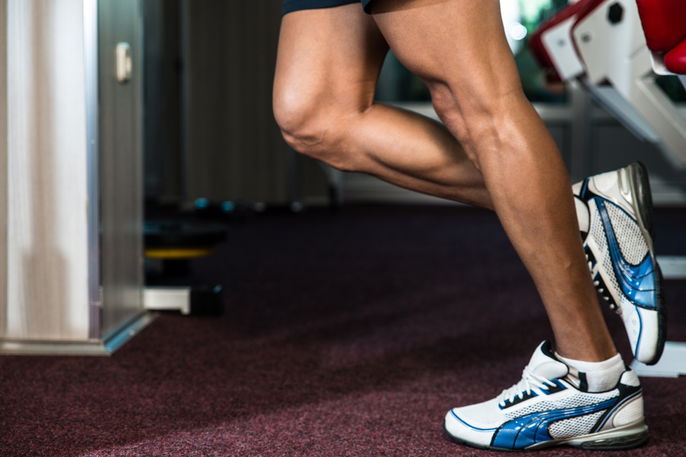
The isolated calf raise is another variation of the classic calf raise, and involves performing the movement on one leg at a time. This exercise is good for ensuring a balance in the development of the muscles of each leg, preventing greater weight from being supported by one of the legs.
To do this calf raise you can again use a step again:
- Climb on a step.
- Keep only the tip of your toes on the ledge, keeping the heel unsupported;
- Hang the other leg in the air, either bent or straight.
- Get up on your tip-toe, pushing your body upwards until the muscle is completely contracted.
- Lower again, letting your heel pass slightly below the level of the step.
- Repeat on the other leg.
To make the exercise easier, you can place the step in front of a wall, to support your hands and avoid falling. This exercise can also be done without the step, with two feet flat on the floor and the other suspended, and can be intensified by holding a dumbbell or weight plate in your hands while performing it.
4. Seated calf raise
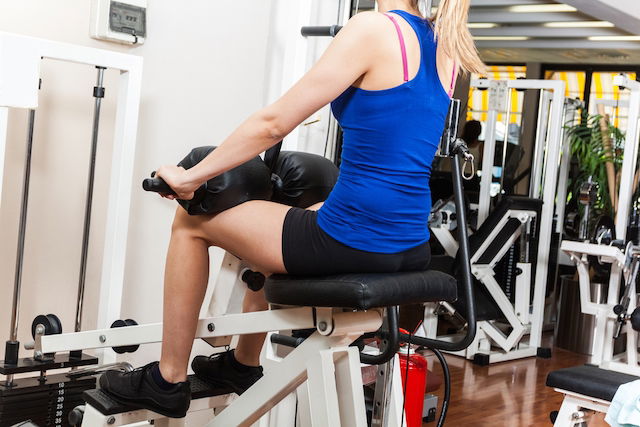
Performing a calf raise while standing or sitting activates your calf muscles differently, so this exercise should always be part of your workout. Although there are specific machines for doing this exercise at the gym, it can also be done using just dumbbells or weights. To do this, you should:
- Sit on a bench so that your knees are bent at a 90º angle
- Place a dumbbell on each knees, keeping your feet flat on the floor.
- Raise your feet to your tip-toes and raise the heel, keeping the toes on the floor.
- Hold the position for 1 second and return to the starting position with your feet well supported.
In this exercise, you should be mindful of the height of the bench. Your hips should not be higher or lower than the knee, as there is a risk of injury to the joint. Furthermore, the weight should be increased gradually, ideally by around the 5th repetition you should feel the muscle burning slightly.
With seated calf raise machines, you can adjust the bench, place the padded weight over the knees and performs the exercise, paying extra attention to the range of movement.
Another equipment that can be used is the machine to perform the leg press, with the person positioning their feet at the ledge of the support plate, so that the heels hang out. It is important to speak to a personal trainer to ensure you are using these machines correctly and accordance with your goals.
5. Jump rope
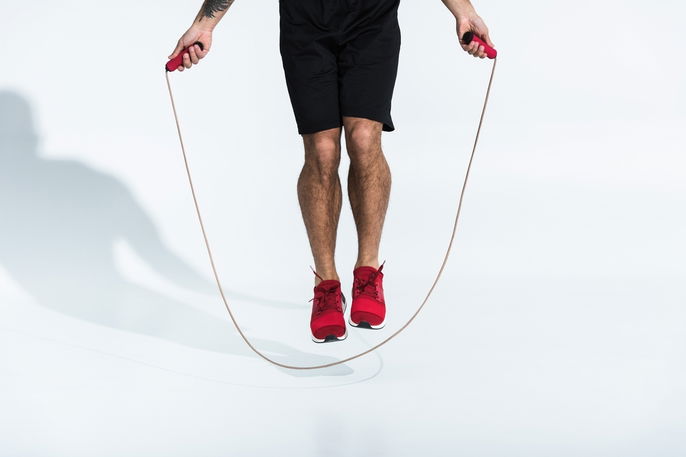
Jumping rope is an excellent exercise for activating your calf muscles. It is important to jump and step on the floor with just the tips of your feet. It is also important to semi-flex your knees when jumping to avoid injuries.
Also recommended: 10 Hamstring Exercises (Gym & Home) with 3 Free Workout Plans tuasaude.com/en/hamstring-exercises6. Calf raises with bent knees
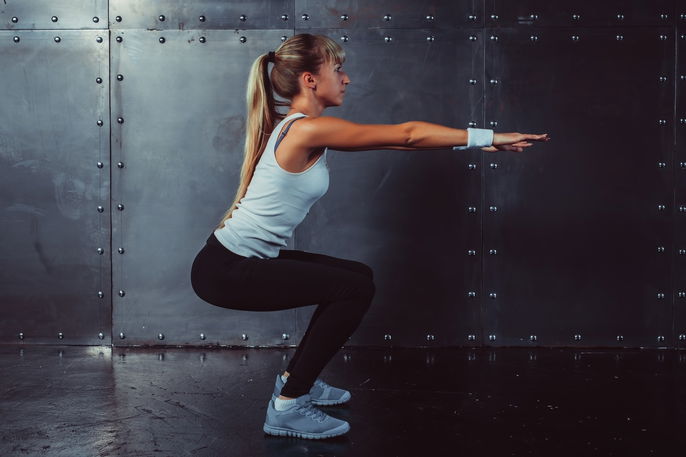
To do calf raises with your knees bent, place your feet shoulder-width apart, keeping the toes pointed forward.
Then, slightly bend your knees, as if you were going to do a squat, keep your toes pressed against the floor and raise your heels as high as possible, returning to the starting position and repeating the movement. It is important that your knees remain flexed throughout the movement.
Free workout plans
Below are two structured calf workout plans that use only the exercises listed above to help improve strength, volume, and muscle activation.
Beginner calf workout plan
This plan helps beginners learn proper technique, build mind-muscle connection, and increase calf endurance. It uses simpler variations and moderate volume.
1. Standing calf raise
- 3 sets of 12 to 15 reps
- 20 to 30 seconds rest
- Focus on slow, controlled movement
2. Calf raises on the step
- 3 sets of 10 to 12 reps
- 20 to 30 seconds rest
- Hold the bottom stretch for 1 second
3. Seated calf raise
- 3 sets of 12 to 15 reps
- 20 to 30 seconds rest
- Keep knees at a 90 degree angle and avoid bouncing
4. Jump rope
- 3 rounds of 30 seconds
- 30 seconds rest
- Land softly on the toes to activate the calves
Weekly frequency: 2 to 3 times per week, allowing at least one rest day between sessions.
Advanced calf workout plan
This plan targets both calf muscles with higher intensity, unilateral work, and increased ranges of motion.
1. Calf raises on the step
- 4 sets of 15 to 20 reps
- 20 to 30 seconds rest
- Use the deepest stretch possible at the bottom
2. Isolated calf raise
- 3 sets of 12 to 15 reps per leg
- 20 to 30 seconds rest
- Hold a dumbbell for extra resistance if available
3. Seated calf raise
- 4 sets of 15 to 20 reps
- 20 to 30 seconds rest
- Pause for 1 second at the top and bottom of the movement
4. Calf raises with bent knees
- 3 sets of 12 to 15 reps
- 20 to 30 seconds rest
- Keep knees flexed the entire time to emphasize the soleus
5. Jump rope
- 3 rounds of 45 to 60 seconds
- 30 seconds rest
- Maintain a quick, light rhythm on the toes
Weekly frequency: Up to 3 times per week, as the calf muscles recover quickly.
Adding these plans to your routine can help strengthen the calf muscles, improve lower leg definition, and support better stability for walking, running, and everyday activities.