


Budesonide is a corticosteroid used to treat respiratory conditions such as asthma and allergic rhinitis. It works by reducing inflammation and swelling in the nasal passages and airways, helping relieve symptoms like nasal itching, sneezing, congestion, and difficulty breathing.
Budesonide is available as an inhaler or a nasal spray under the brand names Pulmicort Flexhaler, Pulmicort Respules, and Rhinocort, as well as in generic forms.
Budesonide can be used by adults and children and should be taken only as prescribed by a healthcare provider for the specific condition being treated.
Indications for use
Budesonide is FDA-approved for the treatment of:
-
Asthma (maintenance therapy) in adults and children 12 months and older (nebulized form) or 6 years and older (inhaler form);
-
Seasonal allergic rhinitis in adults and children 6 years and older (nasal spray form).
Budesonide helps reduce airway inflammation, providing noticeable symptom improvement within about 12 to 24 hours of use.
Although not FDA-approved for this purpose, budesonide may sometimes be used off-label after nasal polyp surgery to help reduce inflammation and prevent recurrence.
This medication should always be used exactly as directed by a healthcare provider, following the prescribed dosage and treatment duration.
Also recommended: Asthma Inhalers: Types & How to Use (Adults, Children & Babies) tuasaude.com/en/asthma-inhalersDosing instructions
The way to use budesonide depends on its form:
1. Budesonide inhaler (Pulmicort)
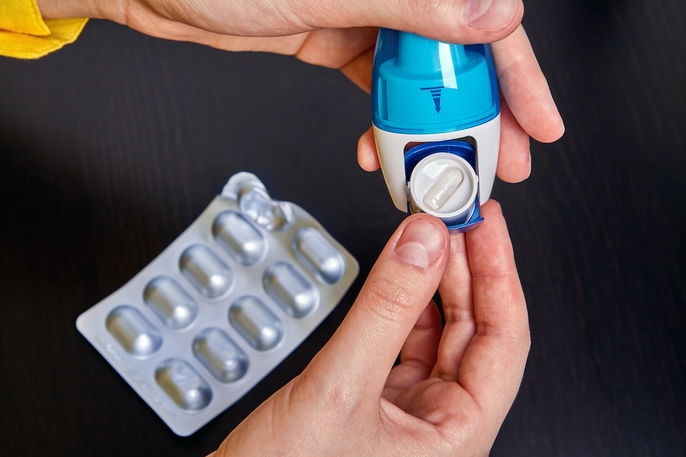
Pulmicort Flexhaler (dry powder inhaler) is available in strengths of 90 mcg or 180 mcg per actuation, delivering 80 mcg or 160 mcg of budesonide, respectively. Dosing varies with age and includes the following:
-
Adults and adolescents (≥12 years): The usual starting dose is 360 mcg twice daily. The maximum recommended dose is 720 mcg twice daily;
-
Children 6 to 17 years: The usual starting dose is 180 mcg twice daily, with a maximum of 360 mcg twice daily.
To use the Flexhaler, breathe out fully before placing the mouthpiece in your mouth, then inhale deeply through the device to draw the medication into your lungs. Hold your breath for about 10 seconds before exhaling slowly.
Rinse your mouth with water and spit it out after each use to reduce the risk of oral thrush.
2. Budesonide nebulizer suspension (Pulmicort Respules)
Pulmicort Respules (nebulizer solution) are indicated for children 12 months to 8 years of age. The dosage depends on prior asthma therapy and typically ranges from 0.25 mg to 0.5 mg twice daily, or up to 1 mg twice daily for children previously treated with oral corticosteroids.
The nebulizer solution should be used exactly as prescribed, and it’s important to follow your doctor’s instructions for using and cleaning the nebulizer device.
3. Budesonide nasal spray (Rhinocort)
Budesonide nasal spray is an aqueous suspension available in 32 mcg doses and is intended for intranasal use. It helps reduce inflammation in the nasal passages to relieve symptoms of allergic rhinitis.
It is important to blow your nose gently before each application. Before using, shake the bottle well to mix the contents. Insert the applicator into one nostril and spray while breathing in gently through the nose.
Recommended dosing includes:
-
Adults and children 12 years and older: 64 mcg (two sprays of 32 mcg in each nostril) once daily. The maximum recommended dose is 256 mcg per day;
-
Children 6 to 11 years: 32 mcg (one spray in each nostril) once daily. The maximum recommended dose is 128 mcg per day.
After each use, rinse the applicator and protective cap with warm water and allow them to air dry before reassembling.
Also recommended: 5 Allergic Rhinitis Medications Your Doctor Can Prescribe tuasaude.com/en/allergic-rhinitis-medicationsSide effects
Common side effects of budesonide nasal spray may include nose irritation or bleeding, runny or stuffy nose, sinusitis, headache, or cough.
Possible side effects of inhaled budesonide (Pulmicort) may include nausea or vomiting, throat irritation, respiratory infections, headache, weight gain, hoarseness or voice changes, oral thrush (Candida infection), indigestion, and cough or dry mouth.
Serious allergic reactions are rare but require immediate medical attention. Stop using the medication and seek emergency care if you experience difficulty breathing, throat tightness, skin blisters, or swelling of the face, mouth, or tongue.
Contraindications for use
Budesonide should not be used by anyone allergic to corticosteroids or any component of the formulation.
It should be used during pregnancy or breastfeeding only if approved by a healthcare provider. Inhaled and nasal forms of budesonide are considered relatively safe in these situations when the potential benefits outweigh the risks.
Budesonide nasal spray should not be used by children under 6 years old, and Pulmicort Flexhaler is also not approved for children under 6. Pulmicort Respules may be used in children 12 months and older under medical supervision.
Important precautions
Do not stop using the medication suddenly without consulting your doctor. Always rinse your mouth after inhaling budesonide to prevent fungal infections.
Inform your healthcare provider if you have tuberculosis, infections, liver disease, or a weakened immune system. Long-term use in children may affect growth, so pediatric patients should be monitored regularly.