


Meditation is a technique that allows your to take your mind to a calm and relaxing state through posture and focusing your attention.
Meditation can help you to reach inner peace and tranquility and can offer many health benefits, such as improvements in stress, anxiety and sleep, as well as focus and productivity at work or school.
Although it is often practiced in classes and specific studios with an instructor, you can also meditate at home or at work, To learn to meditate on your own, you should practice meditation techniques every day for 5 to 20 minutes, once or twice a day.
Health benefits
The possible benefits associated with meditation include:
-
Helps manage depression symptoms;
-
Reduces insomnia and improves sleep quality;
-
Lowers stress and anxiety levels;
-
Increases emotional resilience;
-
Enhances focus, cognitive function, and neuroplasticity;
-
Supports heart health by reducing cardiovascular risks;
-
Assists with weight management and addressing disordered eating;
-
Fosters empathy, compassion, and stronger relationships;
-
Helps reduce burnout and alleviates symptoms of post-traumatic stress disorder.
However, to fully experience the benefits of meditation, this practice should ideally be done on a regular basis.
Types of meditation
The main types of meditation include:
1. Guided meditation
Guided meditation is performed with an instructor, either in person or through digital tools like recordings, podcasts, or mobile apps.
This style directs your attention toward a specific object of focus, which might be your breath, physical sensations, a particular sound, a visual image, or a repeated phrase.
2. Transcendental meditation
Transcendental meditation is a technique involving the use of mantras, which are specific words or phrases repeated either silently or aloud.
The objective is to induce a state of deep relaxation and heightened awareness, allowing the practitioner to move beyond habitual thought patterns to find a profound sense of peace.
3. Shinsokan meditation
Shinsokan meditation is a spiritual practice originating from Seicho-No-Ie, a religious organization with Japanese roots.
Unlike some other secular methods, this practice is designed to lead the practitioner toward a religious experience. It is typically performed while sitting and incorporates chanting, deep breathing exercises, and prayer.
4. Mindfulness meditation
Mindfulness meditation, or mindfulness, is a technique where you observe and accept your current experience without judgment or the urge to change it.
You can practice mindfulness while sitting using focused breathing or body scans, or integrate it into daily activities like walking, driving, or eating.
How to start meditating
To start meditating, you can follow these steps:
1. Block off 5 to 10 minutes per day
Set aside 1 or 2 moments in your day to temporarily “turn-off”. You can meditate once you wake-up (to start your day with less anxiety and more focus), in the middle of the day (to take a break from your activities of daily living), or before going to bed, to slow-down your mind before falling asleep.
Ideally, 5 to 10 minutes are sufficient for achieving all benefits of meditation.
2. Choose a calm space
You should choose a meditating space that you can sit and be calm, like a room, garden, or sofa. You can even sit in your office chair or in the car, after parking and before heading into work.
It is important to choose a space with minimal distractions so you can concentration more easily.
3. Get in a comfortable position
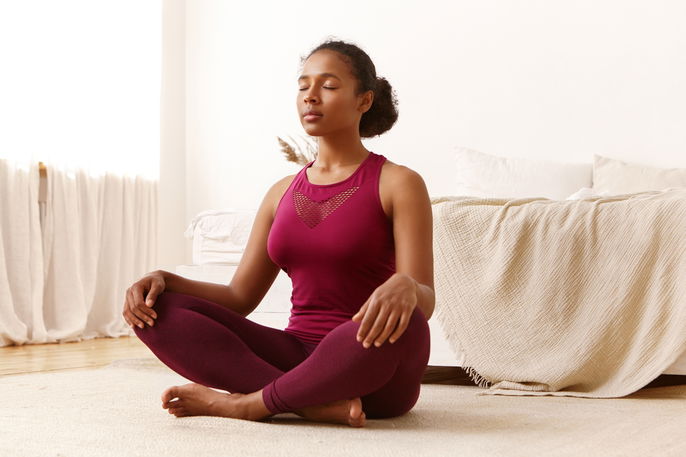
According to oriental traditions, the ideal position for meditation is in the lotus position, with your back straight, legs crossed and your feet resting on your thighs above your knees. However this position is not mandatory, and you can meditate in any sitting or lying position. As long as you are comfortable, ensure your your back is straight, your shoulders relaxed and your neck in-line.
You can also support your hands by resting them in your lap or by placing one on each knee, palms facing up. Once you are comfortable, close your eyes and allow your muscles to relax.
4. Controlling your breathing
It is important to learn how to pay attention to your breathing and to use your lungs to their full capacity. To breathe deeply, pull the air into your belly and thorax. Then exhale slowly and calmly.
Controlling your breathing may not be easy at first, but it should be comfortable and unforced. This exercise can be done by counting to 4 to inhale, another 4 to exhale.
5. Focusing your attention
In traditional meditation, it is necessary to find a focus object to keep your attention on throughout your meditation. Generally, mantras are used, and they can be just a sound, syllable, word or phrase that is repeated over and over in the head to help you concentrate.
You can also use other types of focus objects, like an image, melody, the breeze on your skin your own breathing, or a positive thought. The goal is to keep your mind calm and free of other thoughts.
It is very common to experience other thoughts during meditation. It is important not to fight them, but instead allow them to enter your mind and exit. With time and practice, it will be easier to concentrate and prevent intrusive thoughts.
6. Ending the practice
To finish your meditation practice, you should open your eyes and observe how you feel. To end the session, you can use an alarm or simply stop when you have reached a sense of comfort.