


- Allergy testing can help identify skin, respiratory, food, and medication allergies.
- Common methods include skin prick tests, patch tests, blood tests, oral food challenges, and intradermal tests.
- Some medications and skin conditions can affect test results, so preparation instructions should be followed carefully.
Allergy testing is used to determine whether a person has a skin, respiratory, food, or medication allergy. The results can help a healthcare provider recommend the most appropriate treatment based on how often symptoms occur and how severe they are.
An allergist or immunologist may recommend allergy testing when a person has itching, swelling, or skin redness. Frequent sneezing and a runny nose may also suggest an allergy to substances such as dust, dust mites, latex, insect venom, or animal dander.
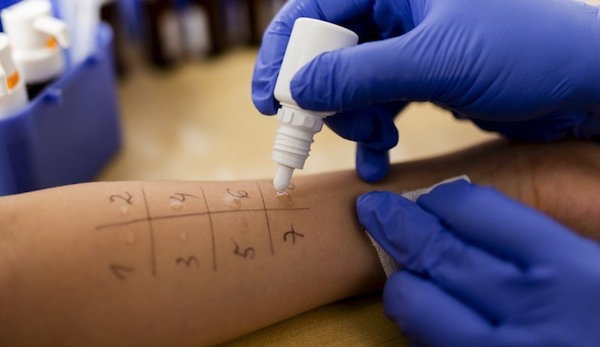
Allergy testing may involve applying a potential allergen to the forearm or back. Food allergies may be evaluated with an oral food challenge, while blood tests can measure antibodies associated with allergic reactions.
When it's recommended
An allergist or immunologist may recommend allergy testing when a person has signs and symptoms of an allergy, such as:
- Itching
- Swelling
- Skin redness
- Swelling of the mouth or eyes
- Frequent sneezing
- Runny nose
- Gastrointestinal symptoms, such as diarrhea
Allergy symptoms may be related to medications, contact with chemicals or certain fabrics, or exposure to dust, dust mites, latex, insect venom, or animal dander.
Foods are another common cause of allergic reactions that may need to be investigated through allergy testing. Common food allergens include milk and dairy products, eggs, and peanuts.
Based on a person's symptoms, a healthcare provider can recommend the most appropriate type of allergy test to help identify the cause.
How to prepare
Before allergy testing, a healthcare provider may recommend temporarily stopping certain medications, including some antidepressants, such as amitriptyline, and antihistamines. These medications may suppress the body’s response to an allergen, interfere with the test results, and potentially cause a false-negative result.
A person should not stop taking any prescription or over-the-counter medication unless instructed to do so by a healthcare provider.
Skin creams should also be avoided, particularly before skin allergy testing, because they may interfere with the results and make a reaction more difficult to evaluate.
The doctor should be informed about skin conditions such as eczema and psoriasis. These conditions may make skin test results more difficult to interpret accurately.
In addition to these recommendations, it is important to follow all instructions provided by the healthcare provider. Proper preparation helps ensure that allergy testing identifies the cause of the symptoms as accurately as possible.
How the test is performed
The way allergy testing is performed depends on the type of allergy being investigated. The main types of allergy testing include:
1. Skin prick test
A skin prick test is performed by placing drops containing small amounts of suspected allergens on the forearm or back. The skin is then lightly pricked or scratched with a sterile device so that the allergens enter the surface layer of the skin.
The test site is usually evaluated after 15 to 20 minutes. A positive reaction typically appears as a raised, red, and itchy bump at the site where an allergen was applied.
Skin prick testing may be used to evaluate possible allergies to foods, dust mites, pollen, animal dander, and insect venom. According to the American Academy of Allergy, Asthma & Immunology, skin test results should be interpreted together with a physical examination and the person’s medical history and symptoms.
2. Patch test
A patch test is performed by placing adhesive patches containing small amounts of suspected allergens on the back. The patches are usually removed after about 48 hours, when the skin is evaluated for a reaction.
Another evaluation may be performed several days later because some allergic reactions develop more slowly.
A patch test is generally used to identify allergic contact dermatitis caused by substances such as metals, cosmetics, fragrances, preservatives, or other chemicals.
3. Oral food challenge
An oral food challenge is used to investigate a possible food allergy. According to the National Institute of Allergy and Infectious Diseases, an oral food challenge is the gold standard for diagnosing food allergies and involves eating gradually increasing amounts of the suspected food under medical supervision.
The amount of food may be gradually increased during the test. The person must remain under close medical supervision throughout the procedure because there is a risk of a severe allergic reaction, including anaphylaxis.
4. Blood test
A blood test can help identify an allergy by measuring allergen-specific immunoglobulin E, or IgE, antibodies produced by the body in response to certain substances. This type of test was previously commonly known as a RAST test.
Blood testing may be recommended for people who cannot temporarily stop taking antihistamines. It may also be used when a skin condition prevents skin testing or makes the results difficult to interpret.
5. Intradermal test
An intradermal test involves injecting a small amount of a suspected allergen just beneath the surface of the skin.
This test may be used when a skin prick test is inconclusive but an allergy is still suspected. It may be performed when evaluating a possible allergy to insect venom, such as bee venom, or to certain medications, such as penicillin.
