


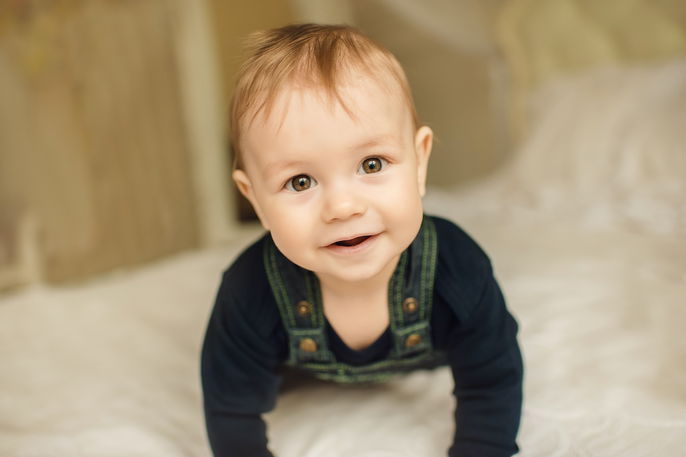
By 8 months old, babies are stronger and can usually sit up on their own and stand for a few seconds with support. They also start to use simple gestures, like waving goodbye or shaking their head to say “no,” and begin to better understand what their parents say.
At this age, many babies can sleep through the night and start eating foods with textures similar to those of the rest of the family, depending on their individual development.
It’s important to remember that every baby grows and develops at their own pace when it comes to growth, sleep, speech, and play. If you have any concerns about your baby’s development, it’s best to talk to your pediatrician.
Growth parameters
The table below shows the average weight range and other key growth parameters for 8-month-old babies, according to the World Health Organization (WHO):
If your baby’s measurements are above or below these ranges, a pediatrician should evaluate their growth and overall development.
Developmental milestones
At 8 months, most babies are typically able to:
-
Move into a sitting position without help;
-
Stand for a few seconds with support, such as by holding onto a chair or sofa;
-
Crawl, although some babies may skip this stage and go straight to walking;
-
Combine syllables like “ma-ma” or “da-da,” though not yet to refer to their parents;
-
Better understand simple questions or commands like “come here” or “where’s mommy?”;
-
Use gestures such as waving goodbye or shaking their head to say “no”;
-
Respond when called by turning or making sounds;
-
Handle objects more precisely, such as picking them up with the thumb and index finger, removing blocks from a container, or banging two toys together.
At this stage, it’s helpful to talk to your baby, read books, sing songs, and play music. These activities help stimulate hearing and language development, encouraging your baby to mimic sounds and words.
Babies at 8 months often dislike being left alone and may feel anxious or upset when their caregivers are out of sight. They also begin to recognize familiar faces and may become shy or uneasy around strangers.
Average sleep
An 8-month-old baby usually sleeps around 14 hours per day, consisting of about 10 to 11 hours at night and 3 to 4 hours during the day in naps. Many babies at this stage can sleep through the night without waking their caregivers.
Baby feeding
According to the American Academy of Pediatrics (AAP), babies at 8 months should continue to receive breast milk and/or infant formula until 2 years of age, while also introducing new solid foods.
A baby’s daily meals at this stage should include two savory purees made with vegetables, grains or tubers (such as rice or potatoes), legumes, and a source of protein plus two fruit meals throughout the day. Check out these baby food recipes.
To help develop your baby’s sense of taste, serve each food separately on the plate. Between 8 and 9 months, babies gradually begin to accept thicker and chunkier textures, similar to those of family meals.
It’s still important to avoid giving your baby foods such as flavored gelatin, candy, or filled cookies. These foods offer little nutritional value and can increase the risk of future health problems, like obesity or diabetes.
Games and activities
At 8 months, babies benefit from games and activities that stimulate intellectual, sensory, and motor coordination skills, such as:
-
Offering toys and objects of different colors, shapes, sizes, and textures;
-
Encouraging your baby to fit objects together, like blocks, balls, or container lids;
-
Playing peekaboo;
-
Placing toys slightly out of reach to encourage movement;
-
Showing floating toys during bath time.
All activities should always be supervised by an adult and take place in a safe environment, ideally on the floor, away from objects that could hurt the baby.