


2 year-old milestones include growing independence, better coordination, and rapid language development. At this age, many children start running and climbing onto furniture or stairs without help, and can sit down and stand up on their own. They also begin to form simple sentences with at least two words and understand basic instructions.
Even with these 2 year-old milestones, emotional development is still catching up. Many 2-year-olds struggle to clearly express their feelings, wants, and interests, which can lead to more challenging behaviors, like refusing to share toys or doing exactly what they were told not to do.
If there are concerns about a 2-year-old child’s growth or development, a pediatrician should be consulted for a full evaluation and appropriate guidance.
Growth chart
The table below shows the ideal weight range for a 2-year-old child, as well as other important parameters such as height and head circumference, according to the World Health Organization:
If a child’s measurements are above or below these ranges, a pediatric consultation is recommended to evaluate the child’s development.
Child's sleep
Sleep is important for the growth and development of a 2-year-old, who typically sleeps between 11 and 14 hours per day, including one or two short daytime naps that total about 1 to 2 hours.
Some children may still wake up during the night. It is advisable for parents or caregivers to check the diaper and temperature and talk calmly with the child to help them fall back asleep. Over time, the child tends to get used to going back to sleep without help.
It is important to emphasize that it is not recommended to let the child sleep in the parents’ or caregivers’ bed, as this increases the risk of accidents, such as falls or suffocation, and can make it harder for the child to learn to sleep alone.
Development of a 2-year-old child
A 2-year-old child usually starts running, jumping with both feet, and climbing onto furniture and stairs without help, and often feels proud of these new achievements.
By age 2, it is also expected that the child can walk, stand up, and sit down independently, form sentences with at least two words, point to at least two body parts when asked, and use gestures such as waving or shaking the head to say “yes” or “no.”
In addition, a 2-year-old child usually understands simple instructions, such as “get your shoes and put them in the drawer,” and may repeat some of the words they hear in conversations.
However, the child still cannot clearly express feelings, wants, and interests, which can lead to more challenging behavior, such as saying “no” frequently, hiding toys to avoid lending them to other children, or reacting more strongly when frustrated.
The “terrible twos”
The so-called “terrible twos” is a change that may occur in the behavior of some children at this age. This happens because, at 2 years old, the child starts to have a strong desire for independence, while also learning that there are rules that must be followed.
This desire to explore the world, combined with limits set by adults, can lead to frustration. As a result, the child may resist instructions from parents or caregivers, throw tantrums, or even pinch other children.
Some suggestions to help parents or caregivers during this phase include:
-
When the child becomes upset, try to stay calm and redirect their attention to another place, situation, or person.
-
Do not give in to the child’s demands during a tantrum, to avoid reinforcing this behavior.
-
Avoid giving long explanations about why the behavior is inappropriate while the child is upset, as they may not understand and may become even more frustrated.
-
If you are out in public, take a deep breath, answer calmly, and bring the child to a quieter place until they calm down.
-
Praise the child whenever they show good behavior.
Understanding and accepting that this behavior is part of a developmental stage can help cultivate patience and calm when dealing with these situations.
Child's diet
A 2-year-old child typically has all their teeth and can eat the same meals as the family, as long as the foods are cut into small pieces.
At 2 years of age, the child should eat 6 meals a day, including breakfast, a mid-morning snack, lunch, an afternoon snack, dinner, and an evening snack, as in the example below:
-
Breakfast: 1 portion of fruit + 1/2 French bread roll with 1 level teaspoon of butter + 3 tablespoons of infant cereal + 200 ml of whole cow’s milk;
-
Mid-morning snack: 1 portion of fruit;
-
Lunch and dinner: 2 tablespoons of rice + 1 tablespoon of beans + 2 tablespoons of cooked beef shank, 1/2 chicken thigh, 1 small chicken fillet, or 1 boiled egg + 1 tablespoon of zucchini or another vegetable + 1 small plate of leafy greens such as lettuce (about 3 medium or 6 small leaves), or 1 tablespoon of cooked leafy greens + 1 portion of fruit;
-
Afternoon snack: 1 portion of fruit, bread, or grains, such as 4 Maria biscuits or 1/2 French bread roll + 200 ml of whole cow’s milk;
-
Evening snack: 200 ml of whole cow’s milk.
At this age, it is recommended to encourage an intake of 480 to 600 ml of cow’s milk per day, preferably fortified with vitamins and minerals, along with other dairy products such as yogurt and cheese, to ensure adequate daily calcium intake.
In addition, fatty foods and foods with a lot of seasonings, including excess salt and sugar, should be avoided. Sweets, chocolates, ice creams, and fried foods are not recommended, as they can contribute to unhealthy eating habits and increase the risk of conditions such as diabetes and obesity.
Water intake
According to the American Academy of Pediatrics (AAP), children aged 1 to 3 years old should drink about 4 cups (32 oz or 950 ml) of beverages per day. This includes both water and milk.
It is important that plain water is always filtered or boiled and offered in a cup, spread throughout the day and between the child’s meals.
Games and activities for the child
Play is essential to stimulate a child’s imagination, creativity, and ability to interact and communicate. Some games and activities for a 2-year-old child include:
-
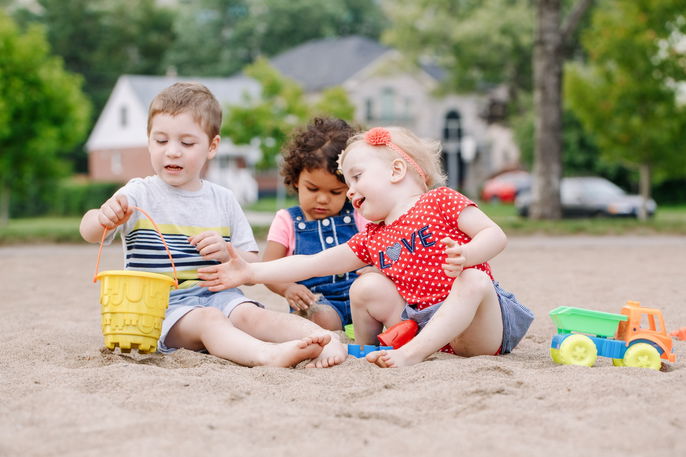
Letting the child play with small shovels, sticks, pebbles, small containers, and sieves in sand at a playground or at the beach, or with plastic containers filled with clean sand. Sit nearby and teach the child to make different drawings in the sand using their feet, hands, and fingers.
-
Creating a matching game by drawing geometric shapes such as circles, triangles, and squares on one sheet of paper and drawing the same shapes on another sheet. Cut out the shapes and ask the child to match them correctly.
Another suggested activity for a 2-year-old is reading books with simple stories and pictures to help stimulate memory, vision, and hearing. You can point to the pictures and ask the child to name animals or objects.