


Trichoepithelioma is a benign skin tumor that develops from hair follicle cells. It causes small, firm bumps, nodules, or lumps that may appear as a single lesion or as multiple tumors, most often on the face.
Also known as Balzer-type sebaceous adenoma, this condition is caused by genetic changes. Symptoms usually appear during childhood or adolescence and are more common in women.
Trichoepithelioma has no cure, but the lesions can be treated by a dermatologist with laser surgery or dermabrasion. Because the lesions often return over time, treatment may need to be repeated.
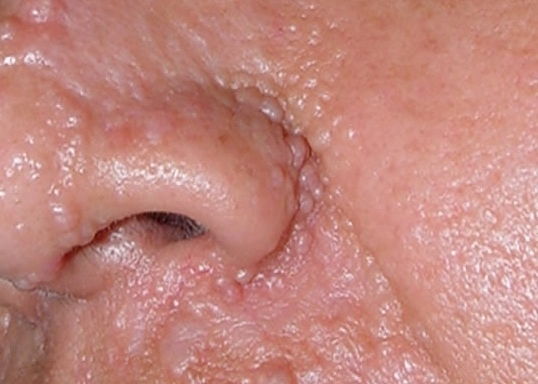
Main symptoms
The main symptoms of trichoepithelioma include:
- Small, firm, skin-colored bumps measuring less than 1 cm in diameter
- One or more lesions that may increase in size and number over time
According to the National Center for Biotechnology Information, trichoepithelioma most commonly appears on the face, although lesions may also develop on the scalp, neck, or torso.
Is trichoepithelioma cancer?
Trichoepithelioma is a benign tumor that develops from hair follicle cells and is not cancerous.
However, in rare cases, the skin lesions may become malignant and develop into trichoblastic carcinoma or basal cell carcinoma.
Confirming a diagnosis
A dermatologist diagnoses trichoepithelioma by reviewing the symptoms, medical and family history, and examining the skin lesions for their appearance and other characteristics.
To confirm the diagnosis, the doctor may order a skin biopsy. This test allows the cells to be examined in a laboratory and helps rule out other skin conditions, such as basal cell carcinoma or an epidermoid cyst.
Possible causes
Trichoepithelioma is linked to genetic mutations involving chromosomes 9p21 and 16q12-q13. In people with a single lesion, symptoms usually develop during the second decade of life.
People with a family history of the condition may have familial multiple trichoepithelioma. In these cases, multiple skin lesions may appear in early childhood or adolescence.
Treatment options
Trichoepithelioma treatment should be guided by a dermatologist. It usually involves laser surgery, dermabrasion, or electrocautery to reduce the size of the bumps and improve the appearance of the skin.
However, the tumors may grow back. For this reason, treatment may need to be repeated regularly to remove new or recurring lesions.
Although this is uncommon, the doctor may perform a biopsy of tumors removed during surgery if malignant trichoepithelioma is suspected. The biopsy results help determine whether more aggressive treatment, such as radiation therapy, is needed.
