


A recessed maxilla is when the upper jaw, also called the maxilla, does not grow forward enough or sits farther back than expected. In medical literature, this is often called maxillary hypoplasia, maxillary retrusion or midface hypoplasia.
This condition can affect the shape of the face, the way the teeth fit together and, in some cases, breathing or speech. Common signs can include a flatter middle part of the face, a concave facial profile, an underbite, crossbite, difficulty chewing, speech changes or sleep-related breathing problems.
Treatment depends on age, growth stage and severity. Options may include orthodontic appliances, rapid maxillary expansion, surgery to move the upper jaw forward or distraction osteogenesis in more severe cases.
Main symptoms
Symptoms of a recessed maxilla can include:
-
Flat or sunken appearance in the middle of the face
-
Concave facial profile
-
Upper jaw that appears set back
-
Underbite or reverse overjet
-
Crossbite
-
Crowded or poorly aligned teeth
-
Difficulty biting or chewing
-
Speech difficulties, especially in people with cleft lip or palate
-
Mouth breathing
-
Snoring or sleep-disordered breathing
-
Reduced nasal breathing in some cases
-
Psychosocial distress related to facial appearance in more severe cases
These symptoms can vary from mild cosmetic changes to problems with biting, breathing or speech. They should be assessed by a dentist, orthodontist, oral and maxillofacial surgeon or craniofacial specialist, especially when they affect chewing, breathing, speech or facial growth.
Possible causes
A recessed maxilla may be caused by:
1. Genetic and growth-related factors
Some people develop a recessed maxilla because the upper jaw does not grow forward enough during childhood or adolescence. This can happen without a cleft or known syndrome. In these cases, the jaw difference may become more noticeable as the face grows and the bite develops.
2. Cleft lip and palate
Cleft lip and palate are important causes of maxillary hypoplasia. In these cases, the upper jaw may grow less than expected, and scarring from earlier cleft surgeries can also affect maxillary growth. This can lead to a concave profile, malocclusion, speech problems and airway concerns.
3. Syndromic or congenital craniofacial conditions
Some craniofacial syndromes can affect midface growth and lead to maxillary retrusion. These cases may involve other changes in the skull, face, teeth or airway. Care is often provided by a team that may include orthodontists, surgeons, speech therapists and other specialists.
4. Mouth breathing and airway obstruction
Long-term mouth breathing in children may be linked with changes in jaw and facial growth. Studies in the attached source list describe associations between mouth breathing, high-arched palate, posterior crossbite, malocclusion and pediatric obstructive sleep apnea. Nasal obstruction and sleep-disordered breathing may therefore be important factors to assess during childhood.
5. Oral habits
Prolonged thumb sucking can affect how the dental arches and bite develop. It may contribute to problems such as crossbite, open bite or other dental changes that can influence the appearance and function of the upper jaw. Early identification of these habits can help reduce the risk of worsening bite problems.
Confirming a diagnosis
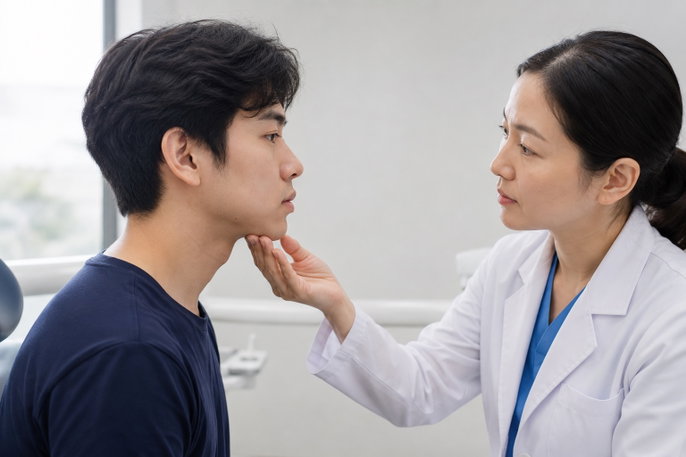
Diagnosis is made through a clinical evaluation of the face, jaw and bite. Doctors and dentists may look for a concave facial profile, a flattened middle face, underbite, reverse overjet, crossbite, dental crowding or signs that the upper jaw is too far back compared with the lower jaw.
Orthodontic assessment may include dental models or digital scans, photographs, X-rays, cephalometric analysis and other imaging tests. Cephalometric measurements can help assess maxillary position, facial proportions and the relationship between the upper and lower jaws.
If breathing problems are present, evaluation may also include airway assessment or referral to an ear, nose and throat specialist or sleep specialist. This is especially important when mouth breathing, snoring, poor sleep or suspected pediatric obstructive sleep apnea is present.
Treatment options
Treatment for a recessed maxilla depends on the person’s age, whether facial bones are still growing, the severity of the jaw difference and whether there are problems with the bite, breathing or speech. Options may include:
1. Orthodontic monitoring
Mild cases may be monitored by an orthodontist, especially in children who are still growing. Regular follow-up can help track jaw growth, dental alignment and bite changes. Early monitoring is especially useful when there is crossbite, mouth breathing, thumb sucking or a history of cleft lip and palate.
2. Rapid maxillary expansion
Rapid maxillary expansion is a common orthopedic treatment used in growing patients with a narrow upper jaw. It works by widening the upper jaw with a dental appliance. This may help improve crossbite, create more space for teeth and, in some cases, support better nasal airflow or sleep-related breathing.
3. Orthodontic appliances
Orthodontic appliances may be used to guide jaw and dental growth in children or adolescents. These appliances may be part of a broader treatment plan for maxillary deficiency, malocclusion or airway-related concerns. The best option depends on growth stage and the specific jaw relationship.
4. Surgically intervention
Surgical intervention may be recommended for adults, some older adolescents or more severe cases of recessed maxilla, especially when facial bones are no longer growing or when orthodontic treatment alone is not enough. Options may include surgically assisted expansion when the upper jaw is too narrow, Le Fort I orthognathic surgery to move the upper jaw forward, or distraction osteogenesis, which slowly moves the upper jaw forward over time.
Surgery may also help adjust the width or vertical position of the upper jaw. Distraction osteogenesis is often considered when the jaw difference is large, when conventional jaw surgery may be less stable or in complex cleft or craniofacial cases.