


A liver biopsy is a procedure in which a doctor collects a small sample of liver tissue to be examined under a microscope. It is used to help diagnose liver diseases, such as hepatitis, fatty liver disease, cirrhosis and liver tumors, as well as assess the extent of liver damage.
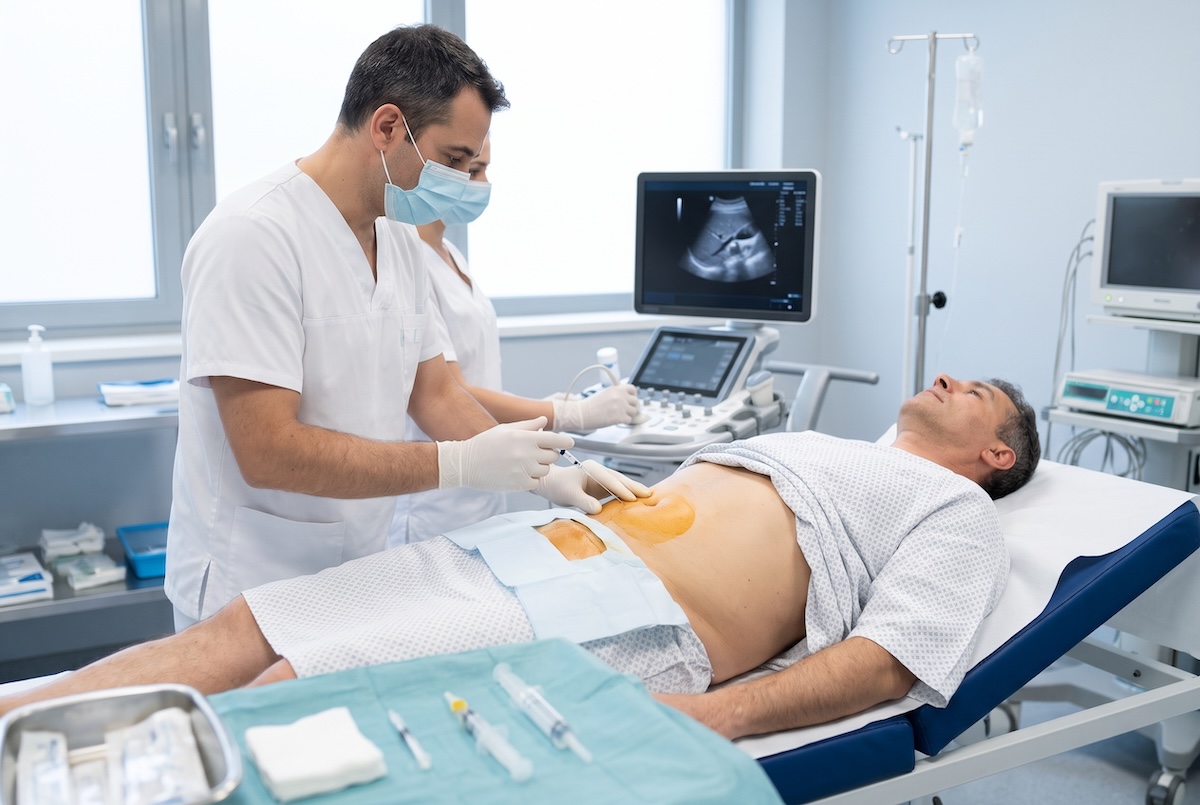
The most common type is a percutaneous liver biopsy, in which a needle is inserted through the skin on the right side of the abdomen to collect a tissue sample. The area is numbed with a local anesthetic, and ultrasound or a CT scan may be used to guide the needle to the correct location.
A liver biopsy is usually performed in a hospital or outpatient center, and most people can return home the same day after a few hours of monitoring. However, someone should accompany the person to the procedure and drive them home, as driving is not recommended afterward.
Indications for testing
A doctor may recommend a liver biopsy to:
- Confirm a liver disease when blood tests and imaging tests, like an ultrasound, are not enough to make a diagnosis;
- See how much inflammation or scarring the liver has, for example in chronic hepatitis or fatty liver disease, now called MASLD;
- Find out what a lump seen on an imaging test is;
- Check for diseases that cause substances to build up in the liver, such as Wilson disease, which causes too much copper;
- Help choose the best treatment and check if it’s working;
- Check the liver after a liver transplant.
Today, many people with long-term liver disease can be checked first with tests that don’t use needles, such as elastography.
This test works like an ultrasound and measures how stiff the liver is, which shows how much scarring there is.
A biopsy is usually only needed when these tests don’t give enough information to make a diagnosis or choose a treatment.
Types of liver biopsy
In a percutaneous liver biopsy, the most common type, the needle is inserted through the skin between the lower right ribs, usually guided by ultrasound or a CT scan.
In a transjugular liver biopsy, the doctor inserts a thin, flexible tube into a vein in the neck, called the jugular vein, and guides it to the liver to collect the sample. This type is usually preferred for people with blood clotting problems or fluid buildup in the abdomen (ascites), because the risk of bleeding is lower. It also allows the pressure in the liver’s veins to be measured at the same time.
Also recommended: Ascites: Symptoms, Causes & Treatment tuasaude.com/en/ascitesA surgical liver biopsy may be done during open or laparoscopic surgery, for example when the person is already having surgery for another reason. Less commonly, the sample can also be collected through an endoscope, using endoscopic ultrasound.
Preparation for testing
Before the procedure, it is important to:
- Tell the doctor about any allergies, health conditions and all medicines and supplements being taken, especially aspirin, blood thinners and anti-inflammatory drugs such as ibuprofen and naproxen;
- Have the blood tests the doctor orders to check blood clotting, as well as any imaging tests needed;
- Follow the doctor’s instructions about fasting, which vary between hospitals;
- Arrange for someone to drive you home.
Medicines that affect blood clotting may need to be stopped for anywhere from a few hours to about 7 days before the biopsy, depending on the medicine. They should only be stopped under medical guidance, since stopping some of them can also be risky.
How it is done
For a percutaneous liver biopsy, the person lies on their back with their right arm raised above or behind their head. The doctor cleans the skin and applies a local anesthetic to numb the area. A sedative may also be given to help the person relax.
The doctor then makes a small cut in the skin and inserts a biopsy needle into the liver to collect a tissue sample. During this step, the person is asked to breathe out and hold their breath briefly to reduce the risk of injury. Usually, only one sample is needed, but additional samples may be collected if the first one is too small.
The tissue sample is then sent to a laboratory, where a pathologist examines it under a microscope.
How long does a liver biopsy take?
A liver biopsy usually takes only a few minutes to collect the tissue sample. However, the entire procedure, including preparation and recovery, can take several hours.
After a percutaneous liver biopsy, the person usually needs to remain lying down for 2 to 4 hours while the medical team monitors their blood pressure and heart rate. After a transjugular liver biopsy, monitoring generally lasts at least 4 hours.
Does a liver biopsy hurt?
A liver biopsy is usually performed under local anesthesia, so most people feel only pressure or mild discomfort when the needle is inserted.
After the procedure, mild pain in the upper right side of the abdomen or right shoulder may occur. This discomfort usually improves within a few hours.
However, severe or persistent pain should be evaluated by a doctor, as it may indicate a complication.
Recovery after a liver biopsy
After a liver biopsy, most people can return home the same day, provided there are no complications.
To help with recovery, it is generally recommended to:
- Rest for the remainder of the day and avoid driving or operating machinery on the day of the procedure;
- Avoid strenuous physical activities, such as running, contact sports or heavy lifting, for at least 48 hours or up to 1 week, depending on the doctor's instructions;
- Take only pain relievers recommended by the doctor;
- Follow the medical team's instructions on how to care for the bandage and biopsy site.
Before leaving the hospital, the person should receive instructions on recovery and when to seek medical attention if any symptoms develop.
Liver biopsy results
Liver biopsy results are usually available within a few days to 2 weeks, although they may take longer if additional tests are needed.
In people with chronic liver disease, the results may include the grade of inflammation and the stage of fibrosis, which indicates the amount of scarring in the liver.
The doctor will review the results and explain whether any treatment or further testing is needed.
Possible complications
A liver biopsy is generally a safe procedure. However, as with any invasive procedure, there is a risk of complications.
Pain is the most common complication. Bleeding may occur in up to 10% of cases, although serious bleeding occurs in fewer than 2% of biopsies.
Most serious complications develop within the first 24 hours after the procedure, which is why medical monitoring is important.
Other less common complications include infection, bile leakage, collapsed lung (pneumothorax), blood accumulation around the lung (hemothorax) and injury to nearby organs, such as the gallbladder or kidneys.
Death related to a liver biopsy is extremely rare.
When to seek medical care
Seek emergency care, or call 911, if any of the following occur after a liver biopsy:
- Severe pain in the abdomen, chest or shoulder, or pain that does not improve with pain relievers;
- Dizziness, fainting, weakness, or a racing or pounding heartbeat;
- Shortness of breath or difficulty breathing;
- Fever or chills;
- Bleeding, redness or swelling at the biopsy site;
- Nausea or vomiting;
- Swelling of the abdomen, or bloody or black, tarry stools.
These symptoms may be signs of internal bleeding, infection or another complication that needs prompt evaluation.
