


Forehead acne refers to pimples, clogged pores or acne-like bumps that develop across the forehead or around the hairline. It can be caused or worsened by hair products, sweat, tight headwear, oily skin products and other substances that remain in contact with the skin.
Hormonal changes, stress, diet and ordinary acne vulgaris can also contribute to forehead breakouts. In some cases, itchy or unusually uniform bumps may be caused by inflammation or yeast growth inside the hair follicles rather than typical acne.
Treatment depends on the underlying cause and may involve changing hair or skin products, reducing friction, using topical acne medicine or receiving prescription treatment. Medical evaluation is recommended when forehead acne is painful, very itchy, widespread, rapidly worsening, leaving scars or not improving with appropriate care.
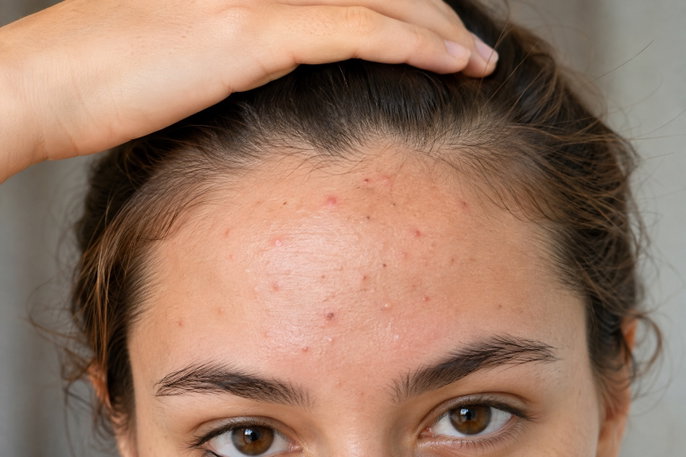
Why is my forehead breaking out?
The main causes of forehead acne include:
1. Hair products, oily hair and product buildup
Hair oils, pomades, waxes, leave-in conditioners, edge-control products and heavy styling creams can spread from the hair onto the forehead. These products may block hair follicles and cause a type of breakout known as pomade acne or acne cosmetica.
The bumps usually appear along the hairline, temples and upper forehead where the product touches the skin. They often include small whiteheads, blackheads or slightly inflamed pimples and may form a band across the edge of the scalp.
What to do: Heavy or oily hair products should be replaced with products labeled oil-free or non-comedogenic. Hair can be kept away from the forehead, and the hairline should be gently cleaned after applying styling products. Benzoyl peroxide or a topical retinoid may help when the bumps continue after the triggering product has been stopped.
2. Pillowcases, hats and other items touching the forehead
Pillowcases, hats, caps, scarves, headbands and helmet liners can collect sweat, oil, dead skin and hair-product residue. Repeated contact may transfer this material back to the forehead or keep it pressed against acne-prone skin.
These items are not considered an independent medical cause of acne, but they may aggravate existing breakouts. The effect may be more noticeable when an item is tight, rarely washed or worn for long periods.
What to do: Pillowcases and washable headwear should be cleaned regularly, particularly when they become oily or sweaty. Tight items can be adjusted or replaced to reduce pressure against the forehead. Products used on the hair should also be considered when residue repeatedly transfers onto bedding or headwear.
3. Sweat, heat and friction
Sweat does not directly cause acne, but sweat mixed with oil, cosmetics and skin products may remain trapped against the forehead. Tight hats, helmets and headbands can also create heat, pressure and repeated rubbing.
This combination can lead to acne mechanica, which is acne caused or worsened by friction and occlusion. Small red bumps, whiteheads or inflamed pimples may appear beneath the area covered by the equipment or clothing.
What to do: The forehead should be gently washed after heavy sweating, without scrubbing or using rough cloths. Headwear and protective equipment should be cleaned regularly and adjusted to reduce rubbing. A clean, soft layer between the equipment and skin may help when the item must be worn frequently.
4. Makeup, sunscreen and skin care products
Some moisturizers, sunscreens, foundations and other cosmetics contain oils or ingredients that may block pores. Applying several heavy products to the forehead can also increase occlusion, particularly in hot or humid conditions.
The resulting breakout may include whiteheads, blackheads and small inflamed pimples in areas where the product is applied. Harsh scrubs, alcohol-based products and excessive washing may further irritate the skin and make inflamed acne appear worse.
What to do: Products labeled oil-free, non-comedogenic or non-acnegenic are less likely to clog pores. Makeup should be removed gently before sleeping, and skin care routines should avoid unnecessary layers of heavy products. The face can be washed up to twice daily and after sweating with a mild, non-abrasive cleanser.
5. Diet
Diet does not cause every case of forehead acne, and no particular food is known to cause breakouts only on the forehead. However, eating patterns that frequently include sugary drinks, sweets, white bread and other high-glycemic foods may be associated with worse acne in some people.
Cow's milk has also been linked to breakouts in some studies, although the evidence is mixed and does not prove that milk causes acne. Food-related patterns can vary considerably, and unnecessary restriction may make it more difficult to maintain a balanced diet.
What to do: A balanced eating pattern with whole grains, vegetables, fruit and other minimally processed foods may be helpful for general skin health. A food and symptom record can help identify whether breakouts repeatedly worsen after a particular food or eating pattern. Major food groups should not be removed without guidance from a doctor or registered dietitian.
6. Hormonal changes, stress and lack of sleep
Hormonal changes can increase oil production and make the follicles more likely to become blocked. This commonly occurs during puberty, menstrual cycles and pregnancy, and may also be associated with certain hormonal disorders.
Hormonal acne is not usually limited to the forehead and may also affect the cheeks, chin, jawline, chest or back. Stress and insufficient sleep may worsen existing acne in some people, although they are rarely the only cause.
What to do: A regular sleep schedule and healthy methods of managing stress may help reduce factors that aggravate acne. Persistent acne associated with irregular periods, increased facial hair, scalp hair loss or other hormonal symptoms should be medically evaluated. Prescription hormonal treatment may be considered when a doctor determines that it is appropriate.
7. Acne vulgaris
Acne vulgaris is a chronic inflammatory condition involving the hair follicles and oil-producing glands. It is the most common medical cause of forehead acne, particularly during adolescence when breakouts often begin in the forehead, nose and chin area.
Acne vulgaris can cause blackheads, whiteheads, red papules, pustules, deep nodules and cysts. Breakouts may also develop on the cheeks, jawline, chest, shoulders and back, while more severe cases can leave dark marks or permanent scars.
What to do: Mild acne may be treated with benzoyl peroxide, a topical retinoid or another suitable topical medicine. Moderate acne may require prescription combinations or an oral antibiotic, while severe or scarring acne may require oral isotretinoin under specialist supervision. Current acne guidelines strongly support benzoyl peroxide, topical retinoids, topical antibiotics and oral doxycycline, with isotretinoin recommended for severe, scarring or treatment-resistant acne.
8. Fungal acne
Fungal acne, or Malassezia folliculitis, occurs when Malassezia yeast grows excessively inside hair follicles. It often develops in oily, sweaty or occluded areas and can be mistaken for ordinary forehead acne.
The condition typically causes many small papules and pustules that are similar in size and appearance. The bumps are often itchy, do not usually include blackheads or whiteheads and may also affect the scalp, chest, back, shoulders or upper arms.
What to do: A doctor may recommend a topical antifungal medicine such as ketoconazole, ciclopirox or clotrimazole. Extensive, recurring or resistant cases may require an oral antifungal after the diagnosis has been confirmed. Reducing prolonged moisture and occlusion may also help, while unnecessary antibiotic treatment can delay the correct diagnosis.
9. Medication-related acneiform eruptions
Corticosteroids and certain other medicines can cause an acne-like eruption that differs from ordinary acne vulgaris. The breakout may begin soon after a medicine is started or its dose is increased.
Numerous papules and pustules that look nearly identical may suddenly appear on the forehead, face, chest, shoulders and back. Blackheads and whiteheads are often absent, and the affected areas may be more widespread than in a typical mild acne breakout.
What to do: A suspected medicine should be reviewed by the prescribing doctor and should not be stopped without medical guidance. The dose may be reduced or an alternative may be considered when this is medically appropriate. Topical retinoids, benzoyl peroxide or prescription oral treatment may be used when the eruption is persistent or severe.
10. Eosinophilic pustular folliculitis
Eosinophilic pustular folliculitis, also known as Ofuji disease, is a rare and recurring inflammatory condition involving the hair follicles. It can produce acne-like lesions on oily areas of the face, including the forehead.
The condition causes very itchy follicular papules and pustules that may join together to form red, ring-shaped plaques. These plaques may have clearer skin in the center, and additional lesions can develop on the cheeks, trunk or limbs.
What to do: Eosinophilic pustular folliculitis requires evaluation and treatment by a dermatologist. Indomethacin is commonly used for the classic form, while other options may include corticosteroids, dapsone, cyclosporine, phototherapy or topical tacrolimus. Any associated immune system condition must also be investigated and treated.
When to seek medical attention
A medical assessment is recommended when forehead acne is painful, deep, rapidly worsening or beginning to leave scars or persistent dark marks. Care is also important when appropriate nonprescription treatment has not produced improvement.
Very itchy bumps, lesions that all look alike, ring-shaped patches, a sudden eruption after starting medication or widespread bumps on the chest and back may indicate a condition other than ordinary acne. A dermatologist can distinguish acne vulgaris from folliculitis and other acne-like disorders and recommend suitable treatment.
