


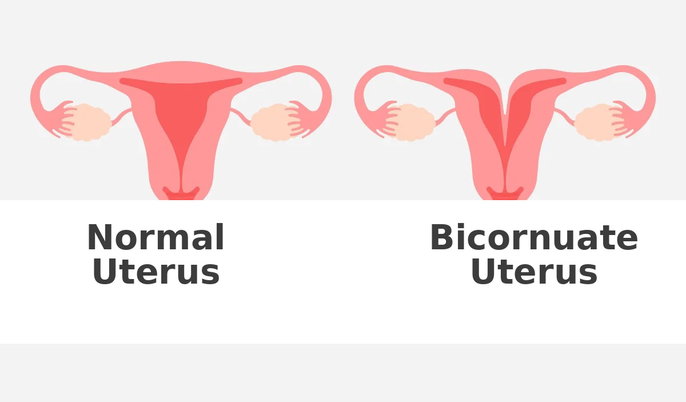
A bicornuate uterus is a rare congenital condition in which the top of the uterus does not fully fuse, creating two uterine “horns” and giving it a heart‑ or “Y”‑shaped appearance. The separation between the two horns can be partial or complete.
Most people with a bicornuate uterus do not experience symptoms, and the condition is often discovered during routine imaging tests such as an ultrasound. Because of this, many women are unaware they have this condition until later in life.
Although it usually does not affect the ability to get pregnant, a bicornuate uterus can increase the risk of miscarriage or preterm birth. For this reason, proper medical follow-up is important, especially during pregnancy.
Main symptoms
The main symptoms of a bicornuate uterus include:
-
Ovulation pain or discomfort
-
Abdominal pain
-
Pain during sexual intercourse (dyspareunia)
However, most cases do not cause symptoms and are often only identified during routine imaging tests in adulthood.
In some cases, a bicornuate uterus occurs together with other genital tract abnormalities, such as a vaginal septum or a double cervix, which may be identified during a gynecological (pelvic) examination, although imaging tests are usually needed to fully assess the uterus and related structures.
Can you get pregnant with a bicornuate uterus?
A bicornuate uterus usually does not affect the ability to get pregnant. However, pregnancy may need closer monitoring because it is associated with a higher risk of complications, including miscarriage, preterm birth, fetal malpresentation, and, in some studies, congenital anomalies in the baby. This may be related to the smaller uterine cavity and irregular uterine contractions.
Confirming a diagnosis
A bicornuate uterus is diagnosed by a gynecologist using imaging tests and is often identified during routine exams.
The doctor may also perform a pelvic exam, although imaging tests are required to confirm the diagnosis.
Imaging tests
The main tests used to diagnose a bicornuate uterus include:
-
Abdominal or transvaginal ultrasound
-
Magnetic resonance imaging (MRI)
-
Hysterosalpingography
-
Sonohysterography
These tests help confirm the diagnosis and assess the extent of the uterine division. According to the American College of Obstetricians and Gynecologists (ACOG), sonohysterography can help evaluate congenital uterine abnormalities and is also used in the assessment of infertility and repeated miscarriage.
Main types
A bicornuate uterus is a type of Müllerian duct anomaly and is classified as class IV by the American Society for Reproductive Medicine.
There are two main subtypes of bicornuate uterus:
1. Bicornuate unicollis uterus (Class IVb)
In this type, the top of the uterus is divided into two “horns,” but there is only one cervix. The uterus looks Y‑shaped or heart‑shaped, with a single opening into the vagina.
2. Bicornuate bicollis uterus (Class IVa)
In this type, the uterus is divided into two “horns” and there are two cervices (two openings from the uterus toward the vagina), because the division goes lower down.
What causes a bicornuate uterus?
A bicornuate uterus is a congenital condition, meaning it is present from birth, although it is often only diagnosed in adulthood.
It develops during embryonic development, when the Müllerian ducts, which normally fuse to form a single uterus, do not fuse completely.
Although it is uncommon, it appears to occur more often in some families, suggesting a possible genetic component.
Treatment options
Treatment is usually not necessary, as most cases do not cause symptoms.
However, a gynecologist may recommend the following:
1. Close prenatal care
For pregnant people with a bicornuate uterus, close prenatal follow-up may be recommended when there is a higher risk of complications.
Regular monitoring during prenatal visits helps reduce the risk of complications.
2. In some cases, surgery
Surgery may be considered for people with a history of recurrent miscarriages, preterm labor, or other poor reproductive outcomes, based on specialist evaluation.
The gynecologist will recommend the best procedure according to the specific uterine anomaly.