


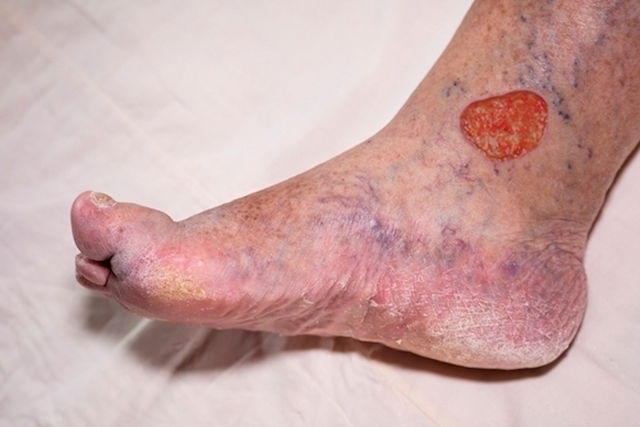
Venous ulcer is a wound that can develop on the legs, especially around the ankle. It usually does not heal easily and may become deeper over time.
A venous ulcer can cause pain and itching. It may also be linked to leg swelling, skin darkening, and thickened skin. A venous ulcer, also called a varicose ulcer, happens because of changes in blood circulation. It may be related to deep vein thrombosis, aging, or the use of certain medications.
Treatment for a venous ulcer should be guided by a dermatologist or vascular specialist. It usually includes compression stockings to help improve local circulation and wound treatments that support healing.
Main symptoms
The main signs and symptoms of a venous ulcer are:
-
Wound that does not heal easily;
-
Wound with irregular, shallow edges, which may become deeper and develop more defined edges over time;
-
Yellowish fluid coming from the wound;
-
Pain, itching, and redness in the area;
-
Swelling around the wound;
-
Darkening and thickening of the skin;
-
Flaking in the area.
A venous ulcer usually appears around the ankle. It may also be associated with other symptoms, such as varicose veins and a feeling of heaviness in the legs.
It is important to see a doctor as soon as signs and symptoms that may suggest a venous ulcer appear. This helps treatment begin early, which can help treat the ulcer and prevent infection and tissue death.
Confirming a diagnosis
A venous ulcer should be diagnosed by a vascular specialist, dermatologist, or primary care doctor. The doctor evaluates the ulcer’s characteristics, such as its location, size, depth, edges, presence of fluid, and swelling in the area.
The doctor also checks for skin thickening, skin darkening, and signs of inflammation.
Possible causes
The development of a venous ulcer is usually linked to circulation problems and may be related to:
-
Deep vein thrombosis;
-
Aging;
-
Obesity;
-
Sedentary lifestyle;
-
Smoking;
-
Standing for many hours.
In addition, pregnancy and the use of medications, such as birth control pills, for example, can cause changes in blood circulation and increase the risk of developing an ulcer.
Also recommended: Poor Circulation in Legs: Symptoms, Causes & Treatment tuasaude.com/en/poor-circulation-in-legsTreatment options
Treatment for a venous ulcer should be done with medical guidance. The goal is to prevent new ulcers, relieve pain, prevent infections, improve venous circulation, and help the existing ulcer heal.
1. Wound cleaning
It is important to clean the wound to prevent infections, which can make the ulcer worse and lead to tissue necrosis.
Cleaning should be done with 0.9% saline solution, which does not interfere with the healing process, does not cause allergic skin reactions, and does not change the skin’s normal microbiota.
After cleaning, the doctor may recommend applying a dressing with hydrogel, alginates, or collagenase ointment, depending on the medical indication. These products can help remove dead tissue and support healing.
2. Use of compression stockings
The doctor may also recommend compression stockings to help stimulate local circulation. This can reduce swelling and lower the risk of new wounds, since compression helps support both microcirculation and macrocirculation.
Graduated compression stockings should be prescribed by a vascular specialist. There are several types, so it is also important to identify the factors that may be related to the circulation changes, allowing the doctor to choose treatment based on the cause.
3. Moving the leg
It is also important to move the leg through walking or physical therapy exercises. This helps activate local circulation and reduce blood pooling, helping prevent new ulcers and recurrence.
4. Use of medications
If a bacterial infection is found in the wound, the doctor may prescribe antibiotics based on the microorganism present in the wound.
5. Surgery
For wounds that are difficult to heal, have not healed with compression therapy and dressings, or are very large, surgery may be recommended.
This surgery is done by placing a skin graft over the ulcer area. A piece of tissue is removed from another part of the body and placed where the ulcer is located, helping the wound heal.
