


Epstein pearls are small, benign cysts that contain keratin and usually appear on the roof of a newborn’s mouth. They look like small white or yellowish bumps and do not cause pain.
Epstein pearls develop near the end of the fourth month of pregnancy, when the palate closes. During this process, small remnants of epithelial tissue can become trapped and form cysts.
This is a benign condition that usually goes away on its own within the first few months of life. It typically disappears before 3 months of age, but it should still be checked during routine visits with a pediatrician.
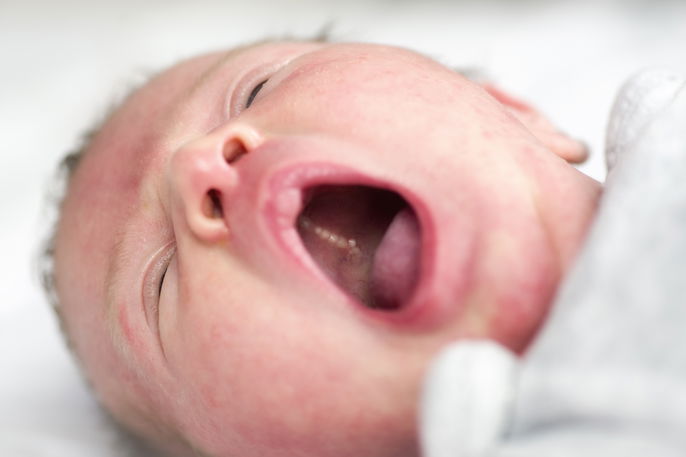
Main symptoms
The main symptoms of Epstein pearls are:
-
Small white or yellowish bumps on the roof of the mouth
-
Small cysts that may look like teeth starting to come in
-
Size ranging from 1 to 4 mm in diameter
Epstein pearls usually appear in groups of 2 to 6 cysts, but they can also appear on their own.
They do not cause pain or discomfort in the newborn. They also do not interfere with sucking or feeding and do not cause signs of inflammation, such as redness or bleeding.
Bohn’s nodules and Epstein pearls
Bohn’s nodules and Epstein pearls are small bumps that can appear in a newborn’s mouth. Both are considered benign and temporary changes.
However, Epstein pearls are more common on the roof of the mouth, usually in the middle area. They occur when tissue remnants become trapped during palate formation before the baby is born.
Bohn’s nodules, on the other hand, appear closer to the gums, along the edges where the teeth will later come in. They are related to small glands in the mouth that leave behind residues during development.
Confirming a diagnosis
Epstein pearls are diagnosed by a neonatologist shortly after birth or by a pediatrician during routine check-ups. The diagnosis is made through direct observation of the lesions.
This is a clinical diagnosis, and imaging or laboratory tests are not required.
Also recommended: Tiny Bumps on Baby Skin: 5 Causes & What to Do (w/ Photos) tuasaude.com/en/tiny-bumps-on-baby-skinPossible causes
Epstein pearls are associated with the normal embryonic development of the oral cavity. During formation of the palate, also known as the roof of the mouth, small portions of epithelial tissue may become trapped under the mucosa, leading to cyst formation.
This usually happens toward the end of the fourth month of pregnancy, when the bony parts of the palate fuse.
Epstein pearls seem to be more common in full-term than in premature babies, and in babies with higher birth weights. They also appear more often in babies born to people who have had multiple pregnancies.
Treatment options
Epstein pearls do not require specific treatment. According to the American Academy of Pediatric Dentistry, Epstein pearls are gingival cysts of the newborn that usually disappear within the first 3 months of life.
In normal situations, medications, procedures, or removal are not needed, and routine follow-up with a pediatrician is enough.
It is also recommended not to try to pop or break Epstein pearls, as this can increase the risk of infection.
