


Cullen's sign appears as purplish or yellowish discoloration around the belly button caused by blood accumulating under the skin. This clinical finding often indicates a serious medical emergency involving internal bleeding within the abdomen.
Also known as periumbilical ecchymosis, this sign typically develops within 48 hours of the initial internal injury. Common causes include severe acute pancreatitis, a ruptured ectopic pregnancy, or significant abdominal trauma.
Cullen's sign is a critical medical emergency that requires immediate evaluation at a hospital. Treatment focuses on identifying the source of bleeding and may involve blood transfusions, IV fluids, or emergency surgery.
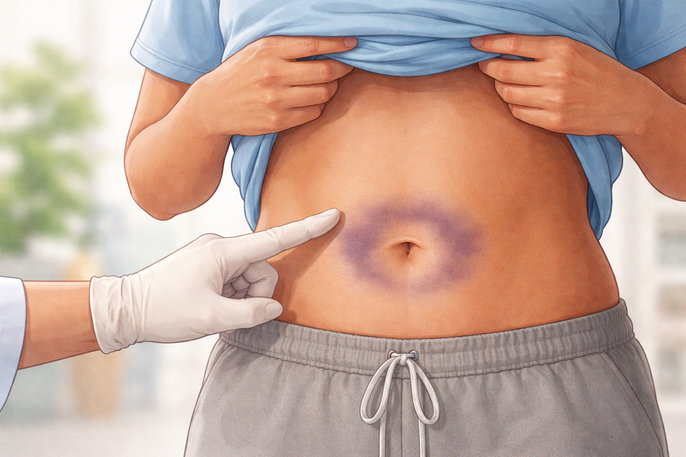
Characteristics of Cullen's sign
The following features are characteristic of Cullen's sign:
-
Discoloration or bruising around the navel.
-
A yellowish tint in cases of minor bleeding.
-
Dark blue, purple, brown, or black coloring in cases of severe bleeding.
-
Swelling of the skin surrounding the belly button.
-
Tenderness or pain when the area is touched.
It is important to note that Cullen's sign is not usually visible immediately; it can take up to two days after the start of internal bleeding to manifest.
Cullen's sign vsGrey-Turner's sign
Both Cullen's sign and Grey-Turner's sign are indicators of severe intra-abdominal hemorrhage. The primary difference lies in their location: Cullen's sign appears directly around the navel, while Grey-Turner's sign appears on the flanks, which is the area between the ribs and the hip.
Confirming a diagnosis
A diagnosis is typically made during a physical examination by a gastroenterologist or a general surgeon. The physician will look for specific bruising patterns around the umbilical region.
To determine the underlying cause of the internal bleeding, doctors may order imaging tests such as a CT scan, MRI, or ultrasound. These tools help locate the source of the hemorrhage and assess for potential complications.
Blood tests are also commonly performed to check levels of pancreatic enzymes, specifically amylase and lipase, if the medical team suspects pancreatitis is the cause of the bleeding.
Causes of Cullen's sign
The most frequent causes of Cullen's sign include:
-
Necrotizing acute pancreatitis.
-
Hemorrhagic acute pancreatitis.
-
Ruptured ectopic pregnancy.
In rarer instances, the sign may be triggered by a ruptured abdominal aortic aneurysm, a ruptured external iliac artery, abdominal trauma, acute appendicitis, a strangulated umbilical hernia, or amebiasis.
What to do
Because Cullen's sign signals a medical emergency, you must proceed to the nearest emergency room immediately. While the sign itself does not have a specific treatment, the underlying cause of the bleeding should be addressed urgently.
For mild or controlled internal bleeding, medical teams may use intravenous (IV) fluids to maintain hydration and stabilize blood pressure.
Blood transfusions are often necessary if the patient has lost a significant amount of blood or shows signs of circulatory instability.
In cases of severe hemorrhage, emergency surgery may be required to find the source of the bleed and stop the loss of blood. This may involve repairing damaged organs or blood vessels, removing injured tissue, or draining blood from the abdominal cavity.
When acute pancreatitis is the cause, the focus is on symptom relief and preventing further complications. This usually involves IV hydration, bowel rest (not eating or drinking), pain management, anti-nausea medication, and close monitoring of oxygen levels.